INQUIRE NOW
Content
Every cubic meter of air pulled into a compressor carries water vapor. When that air is compressed, the same amount of moisture is packed into a smaller volume, raising the relative humidity until condensation becomes unavoidable downstream. Left untreated, this condensate corrodes pipework, washes out lubricants in pneumatic tools, and introduces water droplets into processes that cannot tolerate them, such as spray painting or pharmaceutical packaging. Selecting the correct dryer is not a matter of picking the cheapest unit that fits the pipe diameter; it is an engineering decision built on the required pressure dew point, ambient conditions, and the cost of a moisture-related failure.
This guide compares the three drying technologies most commonly specified in industrial systems, walks through the sizing logic, and gives a structured process for narrowing down the right equipment class before requesting quotes.
Industrial compressed air systems are generally dried using one of three approaches. Each uses a different physical mechanism to remove water vapor, which directly determines the lowest achievable pressure dew point (PDP) and the ongoing energy cost of operation.
The table below summarizes the core specification differences that typically decide which category an engineer starts evaluating first.
| Parameter | Refrigerated | Adsorption (Double Tower) | Combined Low Dew Point |
|---|---|---|---|
| Typical Pressure Dew Point | +3C to +10C | -40C to -70C | -40C to -70C |
| Relative Energy Use | Low | High | Moderate |
| Regeneration Method | Not required | Heatless purge or heated | Heat-of-compression or heated |
| Typical Footprint | Compact | Larger | Moderate |
| Common Applications | General plant air, tools | Instrument air, pharma, electronics | Critical process air, outdoor lines |
Pressure dew point is the single most decisive selection variable. It describes the temperature at which moisture in the compressed air will begin condensing at line pressure. If the lowest ambient temperature the piping will ever see is higher than the dryer's dew point, the system stays dry. If pipework runs outdoors, through unheated spaces, or the process itself is moisture-sensitive, the dew point target has to sit well below the coldest expected condition, not just below room temperature.
As a practical reference, most instrument air and control-system applications specify a pressure dew point of -40C, general plant tool and blow-off applications tolerate +3C to +10C, and cleanroom, pharmaceutical, or outdoor high-altitude pneumatic lines often call for -70C or lower. Painting and coating lines sit in the middle, usually requiring at least +3C dew point with tight filtration to avoid surface defects.
| Application | Recommended Dew Point | Typical Dryer Class |
|---|---|---|
| General workshop tools | +3C to +10C | Refrigerated |
| Spray painting / coating lines | +3C or lower | Refrigerated with coalescing filter |
| Instrument and control air | -40C | Adsorption, double tower |
| Pharmaceutical / electronics | -40C to -70C | Adsorption or combined |
| Outdoor lines in cold climates | Below lowest ambient temp | Adsorption or combined |
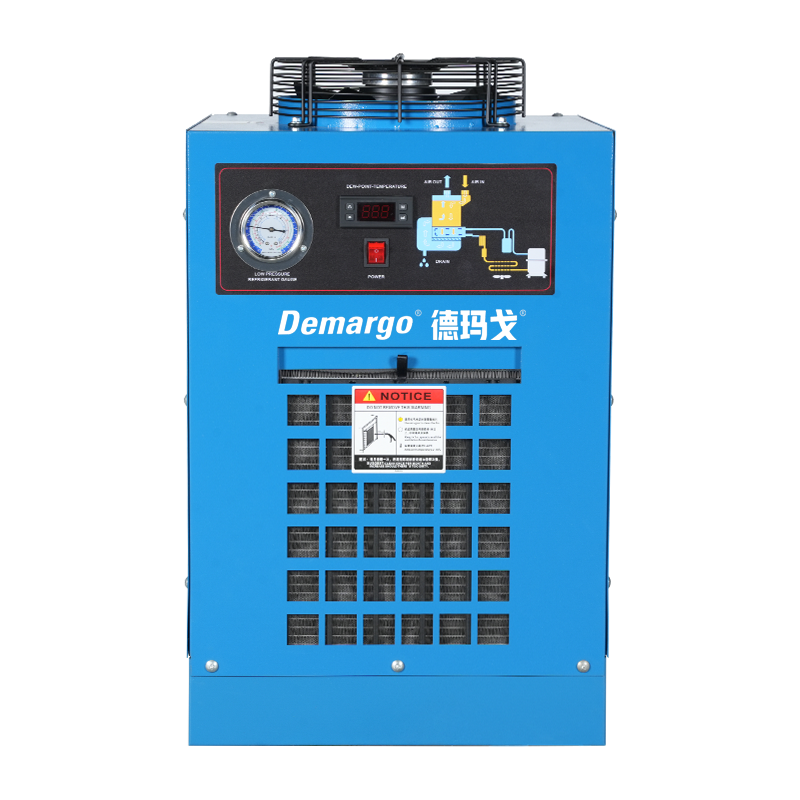
A refrigerated dryer routes compressed air through a heat exchanger cooled by a refrigeration circuit, typically bringing the air stream down to around 2C to 4C. At that temperature most of the water vapor condenses into liquid and is separated out through an automatic drain. The air is then reheated slightly before leaving the unit, both to prevent pipe sweating downstream and to raise the relative humidity reading back to a safe working range.
This design has no consumable desiccant, requires no purge air, and typically uses the lowest specific power per cubic meter of air treated among the three technologies discussed here. Its limitation is a hard floor: it cannot economically achieve dew points colder than the water's freezing point without added complexity, so it is not suited to instrument air, cold outdoor piping, or moisture-critical processes.
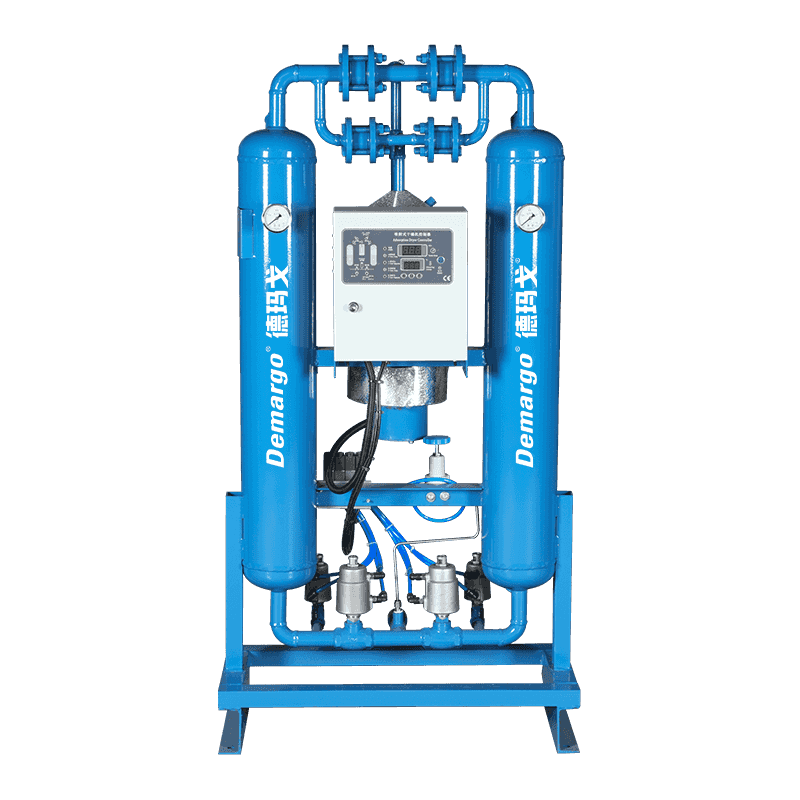
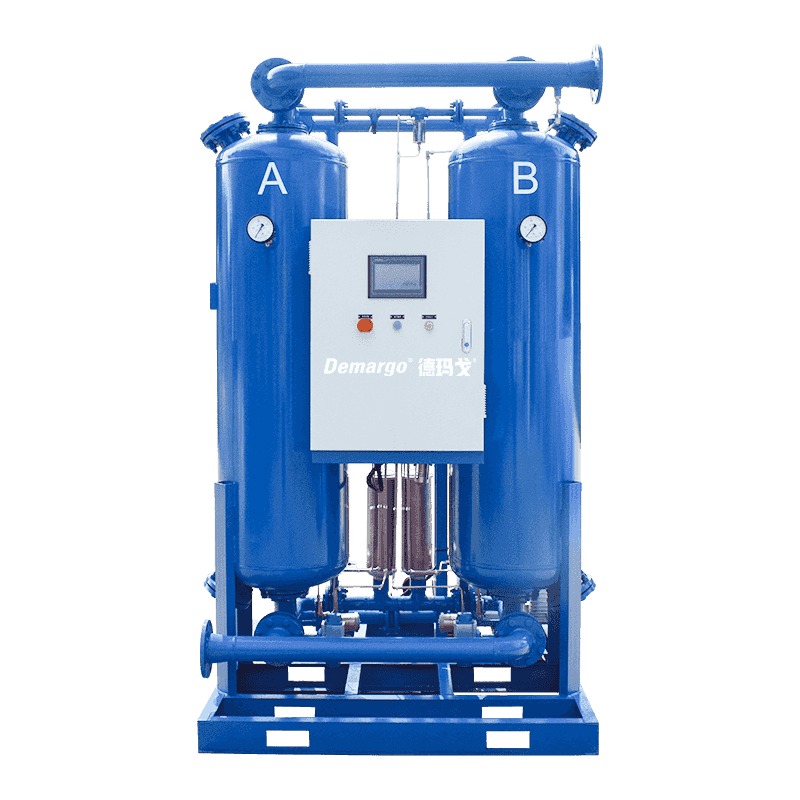
Where refrigeration relies on condensation, an adsorption dryer relies on a solid desiccant material, commonly activated alumina or molecular sieve, that physically binds water molecules onto its surface as air passes through the bed. Because the bed has a finite capacity, two towers are used in alternation: while one tower dries the incoming air stream, the second is regenerated by either a portion of already-dried air expanded to atmospheric pressure (heatless regeneration) or heated purge air (heated regeneration), which drives the collected moisture back off the desiccant.
This cycling allows the system to run continuously while achieving pressure dew points of -40C or lower, well beyond what condensation alone can reach. The tradeoff is energy: heatless designs consume a meaningful percentage of the compressor's output air as purge, while heated designs need supplemental electrical or heat-of-compression energy for regeneration.
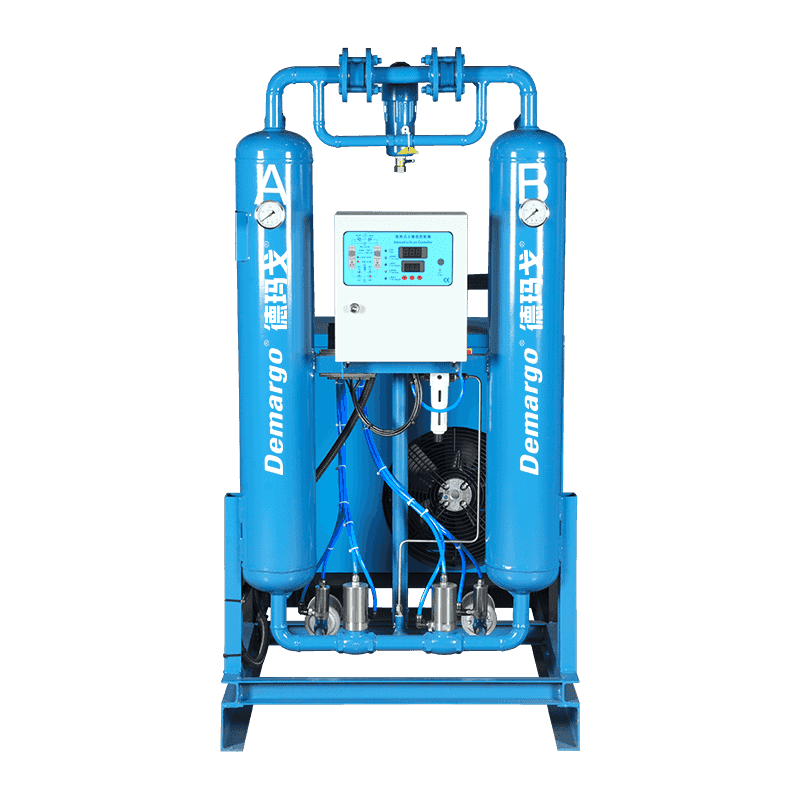
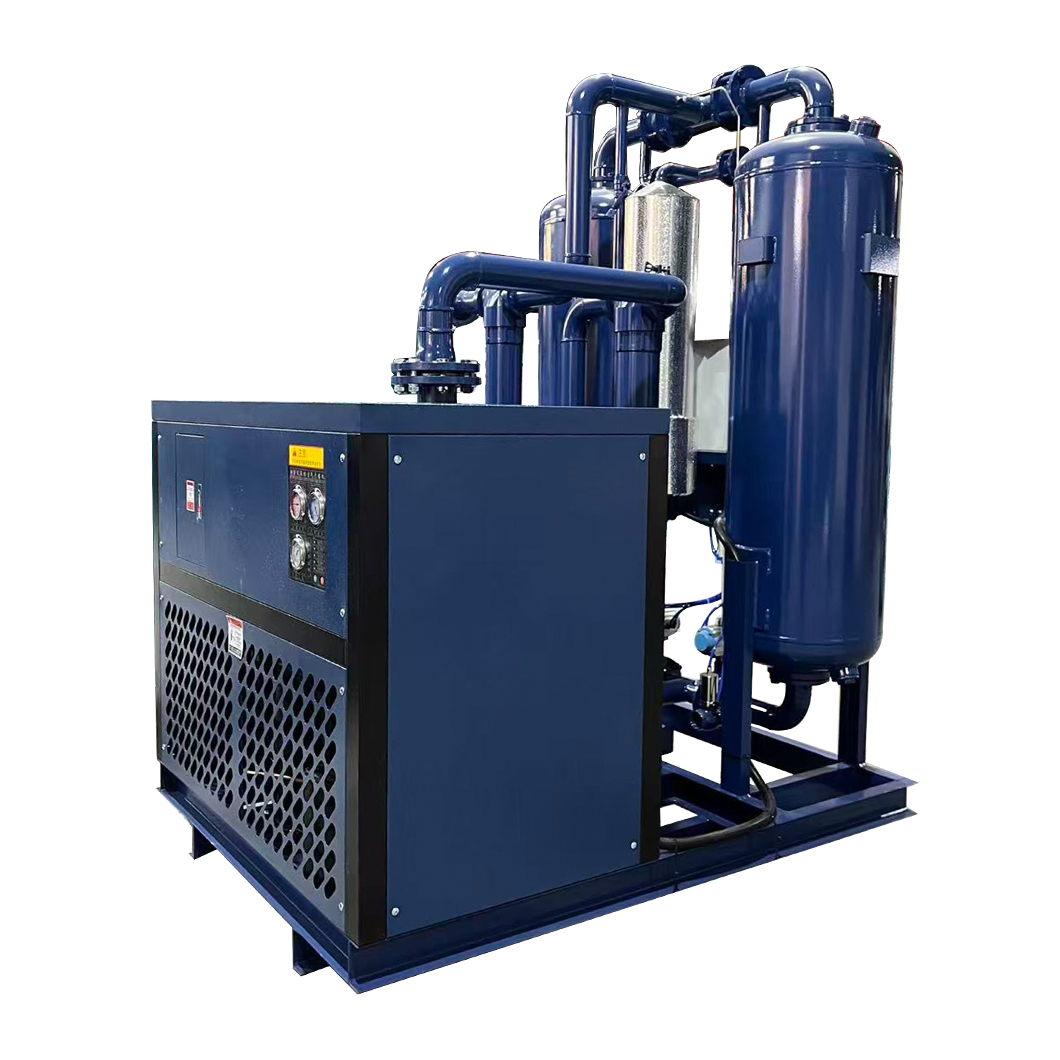
A combined low dew point compressed air dryer stages a refrigeration pre-cooling section ahead of an adsorption bed. Because the refrigeration stage removes the bulk of the water vapor before the air ever reaches the desiccant, the adsorption bed handles a much smaller moisture load, which shrinks the required desiccant volume and cuts the regeneration energy compared with a standalone adsorption dryer sized for the same flow rate.
This layered approach is typically specified where both a very low dew point and continuous high air volume are required at the same time, such as large-scale instrument air headers or process lines that cannot tolerate any downtime for tower maintenance. It carries a higher upfront capital cost than either single-stage technology, but the reduced purge air loss can offset part of that cost over the equipment's service life.
Selecting the right dryer category is only the first step; the specific model must then be sized against three operating variables. Rated capacity on a datasheet almost always assumes a reference inlet condition, commonly 35C inlet air temperature and 7 bar working pressure. Real installations rarely match that reference exactly, so capacity must be corrected.
As the chart illustrates, refrigerated dryer energy demand rises only modestly with inlet temperature, while a heatless adsorption dryer's purge air consumption climbs faster because higher inlet moisture loading forces more frequent or extended regeneration cycles. This is one reason combined systems are favored in hot climates where a standalone adsorption unit's operating cost would otherwise escalate.
Purchase price alone rarely reflects the true cost of ownership. Electricity consumption, desiccant replacement intervals, and purge air loss compound over years of continuous operation. As a general planning index, the chart below expresses relative capital cost across the three dryer classes for an equivalent flow capacity, using the refrigerated dryer as the baseline reference point.
Adsorption and combined systems cost more upfront largely due to desiccant volume, valve automation, and control systems. Facilities should weigh this against the cost of a single moisture-related production stoppage or scrap batch, which in many process industries exceeds the price difference between dryer classes many times over.
The radar chart below summarizes how each dryer class scores across five decision factors on a relative 1-to-5 scale, where a larger area toward a given axis indicates a stronger result on that factor.
Refrigerated units lead on energy efficiency and cost, adsorption units lead on achievable dew point, and combined systems balance dew point depth against footprint at the expense of upfront cost, which is consistent with how these three technologies are positioned across most industrial specification sheets.
Rather than starting from a product catalog, the more reliable approach is to work through the requirement in a fixed sequence before comparing specific models.
Working through this sequence before requesting quotes prevents the common trap of selecting a dryer class based on price first and discovering afterward that it cannot meet the required dew point once real ambient and flow conditions are applied.
Most general workshop and tool applications operate reliably at +3C to +10C, which a refrigerated dryer covers. Instrument air, control systems, and moisture-sensitive processes typically require -40C or lower, which calls for an adsorption or combined system.
A refrigerated dryer cannot be modified to reach sub-zero dew points on its own, but an adsorption unit can often be added downstream of an existing refrigerated dryer to create a combined arrangement, provided the adsorption bed is sized for the pre-dried air load.
Significantly. Rated capacity on a datasheet is typically based on a 35C reference inlet temperature; operating at a higher inlet temperature reduces a refrigerated dryer's effective drying capacity and increases regeneration demand on an adsorption dryer.
For continuous operation, double tower designs are generally preferred because one bed can regenerate while the other dries, avoiding the interruption a single tower design would require during its regeneration cycle.
Refrigerated dryers mainly need condensate drain checks and periodic heat exchanger cleaning. Adsorption dryers require desiccant inspection and periodic replacement, along with valve and seal maintenance for the switching mechanism. Combined systems require both refrigeration-side and desiccant-side maintenance.
Related Products

ADD: No. 9, Lane 38, Caoli Road, Fengjing Town, Jinshan District, Shanghai, China
Tel: 0086-17321147609
Email: [email protected]
Copyright © Demargo (Shanghai) Energy Saving Technology Co., Ltd. Rights Reserved. Custom Gas Purifiers Factory