INQUIRE NOW
Demargo (Shanghai) Energy Saving Technology Co., Ltd.
2024-12-17The difference between a refrigerated air dryer and an adsorption dryer?
2024-12-17Principle and application of modular dryer?
2024-12-17Precautions for using refrigerated air dryers?
2024-12-17Exploring the secrets of future food preservation: Entering the world of high-efficiency freeze-drying technology - refrigerated air dryer
2025-02-20Content
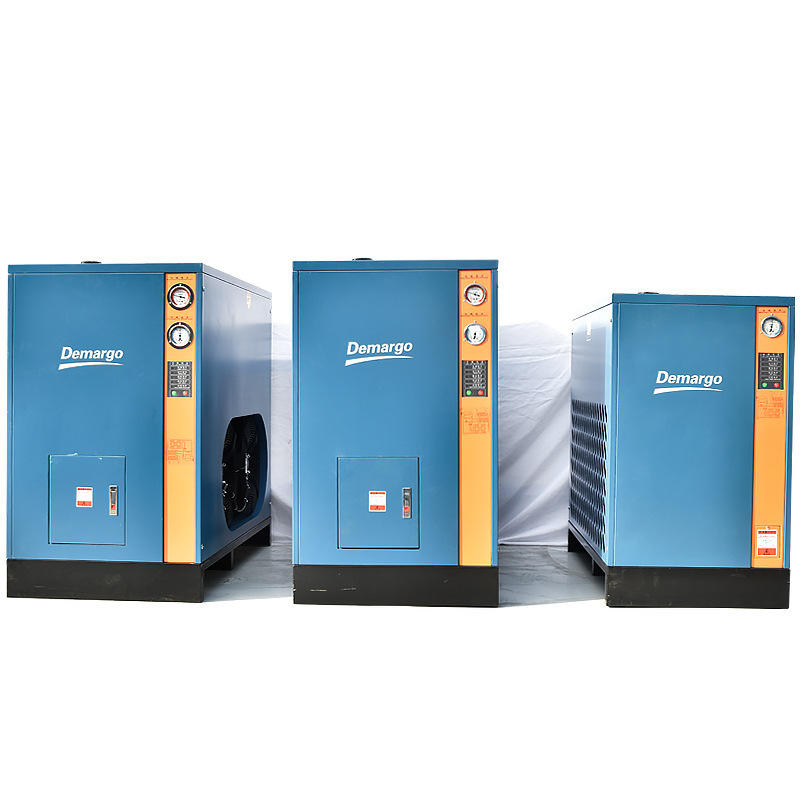
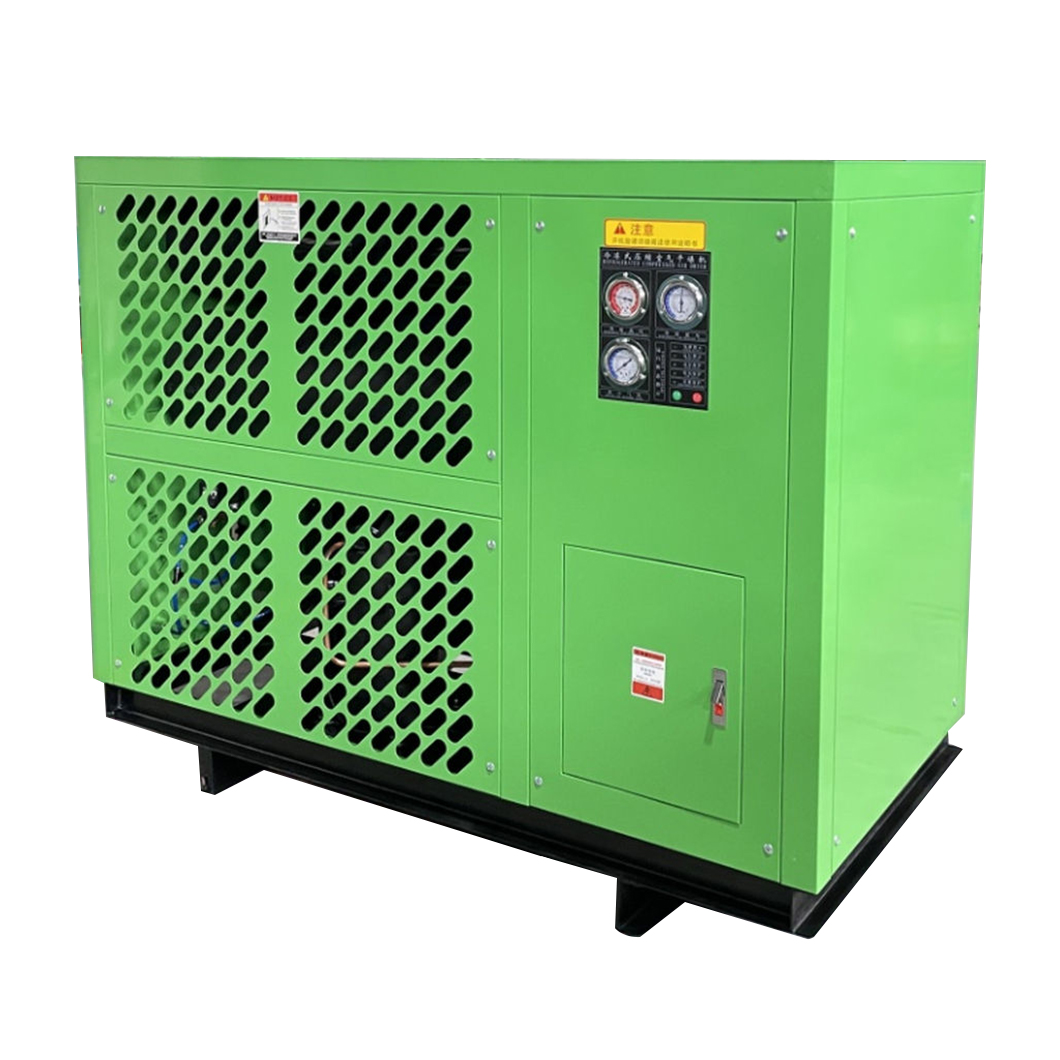
A Compressed Air Refrigerated Dryer removes moisture from compressed air by cooling it to a low temperature — typically to a pressure dew point of +3°C to +10°C (37°F to 50°F) — causing water vapor to condense into liquid, which is then automatically drained away. The result is dry, clean air that protects downstream equipment, tools, and processes from corrosion, contamination, and malfunction.
This is the most widely used air drying technology in industrial settings because it is energy-efficient, reliable, and capable of meeting the moisture requirements of most general-purpose compressed air applications.
Refrigerated dryers follow a clear, repeatable thermodynamic process. Here is how compressed air moves through the system:
The refrigerant itself circulates in a closed loop — compressed by a compressor, condensed in a condenser (air-cooled or water-cooled), and expanded through an expansion valve before entering the evaporator again.
Understanding the individual parts clarifies why each element matters for performance and maintenance.
| Component | Function | Typical Spec / Note |
| Air-to-Air Heat Exchanger | Pre-cools incoming air using outgoing dry air | Reduces refrigeration load by up to 60% |
| Evaporator (Air-to-Refrigerant HX) | Cools air to dew point by transferring heat to refrigerant | Chills air to ~2–5°C |
| Refrigerant Compressor | Pressurizes the refrigerant to drive the cooling cycle | Often hermetically sealed; uses R-134a or R-410A |
| Condenser | Releases refrigerant heat to ambient air or cooling water | Air-cooled models need adequate ventilation |
| Expansion Valve | Drops refrigerant pressure and temperature before evaporator | Thermostatic or electronic types used |
| Moisture Separator | Collects condensed water droplets from air stream | Centrifugal or coalescing design |
| Automatic Drain Valve | Expels collected condensate without air loss | Timer-based or zero-loss electronic type |
| Hot Gas Bypass Valve | Prevents evaporator freeze-up at low loads | Critical for cycling-type dryers |
There are two main operating modes, and the right choice depends on how consistently your compressor runs.
The refrigerant compressor runs continuously regardless of air demand. These units are simpler and lower in upfront cost, but they consume the same energy whether the air system is at full load or idle. They are best suited for facilities with consistent, high air demand throughout the day.
The refrigerant compressor switches on and off in response to thermal load, using a large thermal mass (glycol or eutectic solution) to maintain stable dew point even during off cycles. Cycling dryers can reduce energy consumption by 30–60% in variable-demand applications. They cost more upfront but deliver significant operating savings over time.
| Feature | Non-Cycling | Cycling |
| Energy use at partial load | Full power | Reduced (30–60% savings) |
| Upfront cost | Lower | Higher |
| Dew point stability | Consistent | Consistent (via thermal mass) |
| Best application | Constant high demand | Variable or intermittent demand |
| Maintenance complexity | Lower | Slightly higher |
The pressure dew point (PDP) is the temperature at which moisture will condense in a pressurized air system. A refrigerated dryer typically achieves a PDP of +3°C to +10°C, which corresponds to ISO 8573-1 Class 4 air quality.
This level of dryness is sufficient for:
Applications requiring a PDP below 0°C — such as outdoor pipework in freezing climates, pharmaceutical production, or electronics manufacturing — will need a desiccant dryer, which can achieve PDPs as low as -40°C or -70°C.
A refrigerated dryer's rated flow capacity is based on standard inlet conditions. Real-world performance changes when these conditions vary.
Correct sizing prevents both under-drying and unnecessary energy expenditure. Follow these practical rules:
Refrigerated dryers are low-maintenance compared to desiccant systems, but neglect leads to poor dew point performance and premature component failure.
| Task | Frequency | Why It Matters |
| Clean condenser fins | Monthly (dusty environments) / Quarterly | Prevents high head pressure and reduced cooling |
| Check and test automatic drain | Weekly | A blocked drain floods the air system with water |
| Inspect pre-filters and replace element | Every 2,000–4,000 hours or per ΔP indicator | Protects heat exchangers from oil and particle fouling |
| Verify dew point output | Quarterly | Confirms system is drying to specification |
| Check refrigerant pressure | Annually (by certified technician) | Low refrigerant causes poor dew point and compressor damage |
| Inspect electrical connections | Annually | Loose terminals cause overheating and control failures |
Both technologies remove moisture from compressed air, but they serve different applications.
In some high-demand industrial facilities, both types are used together: a refrigerated dryer handles the bulk of moisture removal, and a desiccant dryer provides the final deep-drying stage — maximizing efficiency while meeting stringent dew point targets.
Typically +3°C to +10°C, meeting ISO 8573-1 Class 4 air quality. This suits most general industrial applications.
Air-cooled models perform best below 40°C ambient. Above that, efficiency drops significantly and water-cooled units are recommended.
Power consumption varies by size. A typical unit for a 7.5 kW compressor may use 0.3–1.5 kW. Cycling models reduce this further at partial loads.
No. It removes water vapor only. Oil aerosol removal requires a dedicated coalescing filter installed downstream.
Refrigerant does not need periodic replacement in a sealed system. Loss of refrigerant indicates a leak, which requires professional diagnosis and repair.
Condensate accumulates and is carried downstream, causing corrosion, water hammer, and contamination of processes or products. Check drains weekly.
Yes. Non-cycling dryers running far below their rated flow may experience short-cycling or evaporator freeze-up. Correctly size to actual system flow range.
Related Products

ADD: No. 9, Lane 38, Caoli Road, Fengjing Town, Jinshan District, Shanghai, China
Tel: 0086-17321147609
Email: [email protected]
Copyright © Demargo (Shanghai) Energy Saving Technology Co., Ltd. Rights Reserved. Custom Gas Purifiers Factory