INQUIRE NOW
Demargo (Shanghai) Energy Saving Technology Co., Ltd.
2024-12-17The difference between a refrigerated air dryer and an adsorption dryer?
2024-12-17Principle and application of modular dryer?
2024-12-17Precautions for using refrigerated air dryers?
2024-12-17Exploring the secrets of future food preservation: Entering the world of high-efficiency freeze-drying technology - refrigerated air dryer
2025-02-20Content
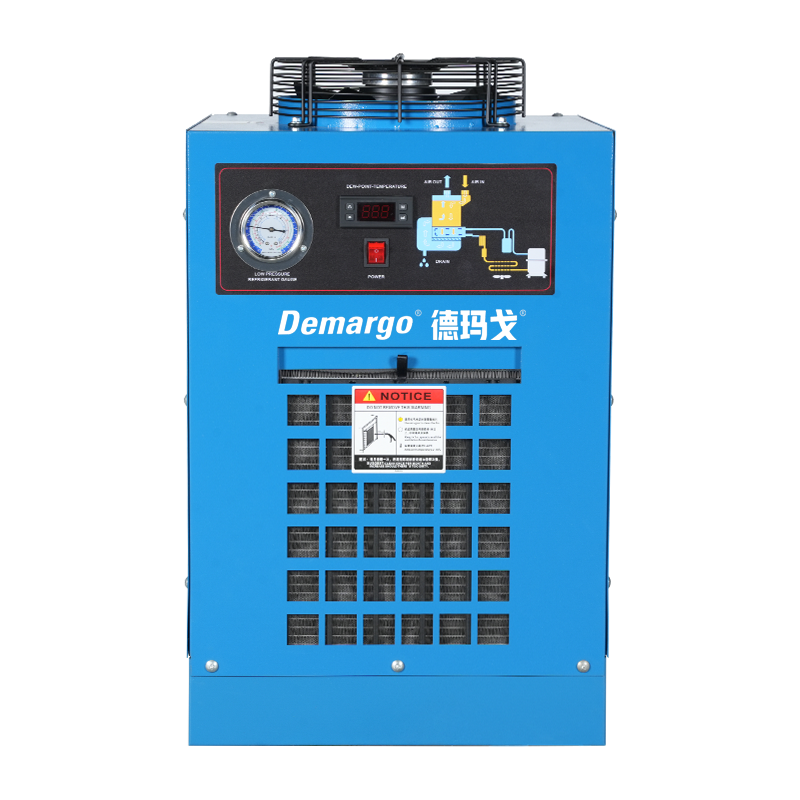
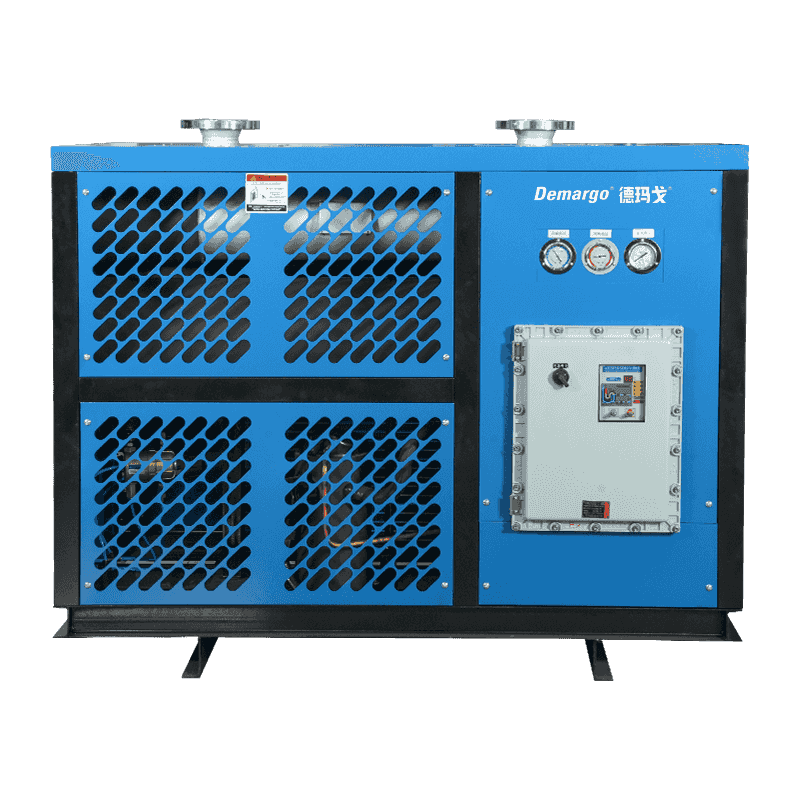
A compressed air refrigerated dryer is an essential component in many industrial and manufacturing processes where high-quality compressed air is required. Its primary function is to remove moisture from compressed air, preventing corrosion, equipment damage, and production inefficiencies. In industrial settings, selecting the appropriate dryer design is critical for achieving optimal performance and operational reliability. Among the most widely used designs are microchannel and shell-and-tube heat exchangers.
A compressed air refrigerated dryer works by cooling compressed air to remove water vapor. Moist air enters the dryer and passes through a heat exchanger, where its temperature drops, condensing moisture into liquid form. This liquid is then removed by a condensate drain, ensuring that the compressed air leaving the dryer is dry and suitable for sensitive equipment or processes.
The efficiency and performance of a compressed air refrigerated dryer largely depend on the design of its heat exchanger. Heat exchangers are responsible for transferring thermal energy from the compressed air to a refrigerant medium. The two primary designs in modern systems are microchannel and shell-and-tube. Each design has specific advantages, limitations, and ideal applications.
Microchannel heat exchangers are compact devices that use multiple small, flat channels to circulate refrigerant. The channels are typically made from aluminum, which provides excellent thermal conductivity. Air flows over these channels, allowing rapid heat transfer between the compressed air and the refrigerant.
Key characteristics of microchannel designs include:
Microchannel heat exchangers provide several operational advantages:
Despite their advantages, microchannel designs have limitations:
Shell-and-tube heat exchangers are a traditional design widely used in industrial compressed air systems. They consist of a cylindrical shell containing a bundle of tubes. Compressed air flows through one side (either the shell or the tubes), while the refrigerant flows through the opposite side. Heat is transferred through the tube walls, resulting in efficient cooling and condensation of water vapor.
Key characteristics of shell-and-tube designs include:
The benefits of shell-and-tube designs include:
Despite their advantages, shell-and-tube designs have some drawbacks:
The differences between microchannel and shell-and-tube designs can be summarized across several key aspects:
| Feature | Microchannel Design | Shell-and-Tube Design |
|---|---|---|
| Size and footprint | Compact, lightweight | Larger, heavier |
| Thermal efficiency | High per unit volume | Moderate per unit volume |
| Pressure tolerance | Lower | High, suitable for industrial pressures |
| Maintenance | Difficult, requires replacement | Easier, tube bundles can be serviced |
| Sensitivity to air quality | High, requires clean, filtered air | Lower, tolerates some particulates |
| Refrigerant charge | Low | High |
| Installation flexibility | Limited, space-saving | Requires more space and support |
| Operational cost | Lower energy consumption | Slightly higher energy consumption |
This comparison highlights that microchannel designs excel in compact applications with clean compressed air and space constraints, while shell-and-tube designs are better suited for high-pressure, heavy-duty industrial environments.
When selecting between microchannel and shell-and-tube compressed air refrigerated dryers, industry requirements play a crucial role.
Microchannel dryers are commonly used in:
Shell-and-tube dryers are ideal for:
Both designs require careful maintenance to ensure optimal performance, but the approaches differ.
Proper maintenance improves compressed air quality, enhances energy efficiency, and prolongs equipment lifespan, regardless of design.
Selecting the appropriate dryer involves evaluating several key factors:
Understanding the differences between microchannel and shell-and-tube designs is critical for selecting a compressed air refrigerated dryer that meets industrial requirements. Microchannel designs offer compact size, high thermal efficiency, and lower energy consumption, making them ideal for light industrial applications with clean compressed air. Shell-and-tube designs provide durability, high-pressure tolerance, and easier maintenance, suiting heavy-duty industrial environments with larger compressed air demands.
Industrial decision-makers should assess their operational conditions, including air quality, pressure requirements, maintenance capacity, and installation constraints, before choosing the appropriate design. By considering these factors, facilities can achieve reliable, energy-efficient, and cost-effective compressed air drying solutions that support long-term operational goals.
Related Products

ADD: No. 9, Lane 38, Caoli Road, Fengjing Town, Jinshan District, Shanghai, China
Tel: 0086-17321147609
Email: [email protected]
Copyright © Demargo (Shanghai) Energy Saving Technology Co., Ltd. Rights Reserved. Custom Gas Purifiers Factory