INQUIRE NOW
Content
Compressed air rarely appears on a food safety audit checklist in the same way that raw material sourcing or sanitation logs do, yet it touches product more directly than almost any other utility on a processing floor. Air is blown across bottles before filling, used to convey powders through pipework, injected into dough to control texture, and applied directly onto exposed product surfaces during packaging. When that air carries oil aerosols, rust particles, or condensed moisture loaded with bacteria, the contamination pathway is just as real as an unwashed hand or a dirty conveyor belt.
The challenge is that compressed air contamination is invisible during normal operation. A compressor room can look spotless while the air leaving it carries particulate counts, oil vapor, and water content that would never be tolerated if they were visible on a stainless steel table. This is exactly why standards bodies built quantitative classification systems for compressed air quality, and why processors handling exposed or ingested product increasingly treat air treatment equipment as a control point rather than a background utility.
Part of the reason compressed air gets overlooked is organizational. Utility systems are typically owned by maintenance or engineering teams, while food safety ownership sits with quality assurance. Without a shared checklist connecting the two, a compressor upgrade can happen without anyone re-evaluating whether the existing filtration train is still adequate for the new flow rate, or a new product line can be added to a plant without anyone checking whether the air feeding it meets the required purity class for that specific application. Closing this gap usually requires a single documented air quality specification that both teams reference, rather than leaving air treatment decisions to whichever department happens to notice a problem first.
Three contaminant categories dominate compressed air risk assessments in food environments: particulates, oil residues, and moisture. Each behaves differently and requires a distinct control strategy, which is why single-stage filtration is rarely sufficient for direct or indirect food contact applications.
| Contaminant | Typical Source | Food Safety Consequence |
|---|---|---|
| Rust and pipe scale | Aging distribution piping | Physical contamination, foreign material complaints |
| Compressor lubricant aerosol | Oil-lubricated compressors | Off-flavor, allergen concern, coating failure on product contact surfaces |
| Condensed water | Compression heat loss, ambient humidity | Bacterial and mold growth inside pipework and at point of use |
| Ambient dust and pollen | Unfiltered intake air | Elevated bioburden, filter loading, product surface contamination |
| Biofilm fragments | Standing condensate in low points | Intermittent, hard-to-trace microbial spikes in finished product testing |
The most operationally damaging of these is moisture, not because it is toxic on its own, but because it is the enabling condition for the other three. A dry pipe network resists biofilm formation and slows corrosion; a wet one accelerates both. This is why dew point control sits alongside filtration as a core design decision rather than an optional upgrade.
Investigations into unexplained microbial excursions frequently trace back to compressed air only after other, more obvious sources have been ruled out, simply because air is not the first place a quality team looks. Swab testing at the point of use, differential pressure trend review across the filtration train, and inspection of any low points or dead legs in the piping run are the three checks that most consistently identify air as the contributing factor once product contact surfaces and raw materials have been cleared.
ISO 8573-1 remains the reference framework for classifying compressed air purity, expressing particulate count, oil content, and pressure dew point as separate numerical classes rather than a single pass or fail rating. Food and beverage applications with direct product contact are commonly specified against Class 1 or Class 2 for oil content, with dew point requirements tightened further for applications sensitive to moisture, such as pneumatic conveying of hygroscopic powders.
| Air Quality Class | Typical Application | Practical Requirement |
|---|---|---|
| Class 1 (oil) | Direct product contact, open product exposure | Oil content at or near the lowest measurable threshold |
| Class 2 (oil) | Indirect contact, packaging line actuation near product | Trace oil tolerated, still requires coalescing filtration |
| Low dew point class | Powder conveying, cold storage pneumatics, freeze-sensitive lines | Pressure dew point well below ambient minimum to prevent condensation |
Third-party food safety schemes reference this classification indirectly. Audit protocols under BRCGS and SQF typically require documented evidence that compressed air used in product zones has been risk-assessed, filtered appropriately, and tested on a defined schedule, rather than prescribing exact numeric limits themselves. In practice, auditors expect to see a compressed air quality plan that references a recognized classification system, equipment specification sheets showing filtration and dew point capability, and periodic verification records. Processors that cannot produce this documentation frequently receive findings even when no contamination event has occurred, because the absence of a control plan is itself treated as a gap.
It is worth noting that these schemes generally do not mandate a single named piece of equipment or a specific brand of dryer or filter. What they require is evidence of a coherent, risk-based control strategy: a written specification for each product zone, equipment selected to meet that specification, and a verification schedule proving the equipment is performing as designed over time. This flexibility is helpful for facilities retrofitting older plants, since it allows air treatment upgrades to be phased in by risk priority rather than requiring a wholesale system replacement in a single capital cycle.
Effective food-grade air treatment is rarely a single device. It is a sequence of stages, each removing a narrower band of contaminant than the one before it, so that the final filter is protected from loading and can be sized for the fine-particulate and oil-vapor duty it is actually meant to perform.
Housing material matters as much as filter media selection in wash-down or high-humidity processing environments. A stainless steel compressed air filter resists the corrosion that carbon steel or coated aluminum housings develop under repeated caustic wash-down, and avoids introducing a second source of particulate contamination from a corroding housing wall. This is particularly relevant for filters installed close to open product zones, where housing integrity failure has a direct path to the product stream rather than being contained within a mechanical room.
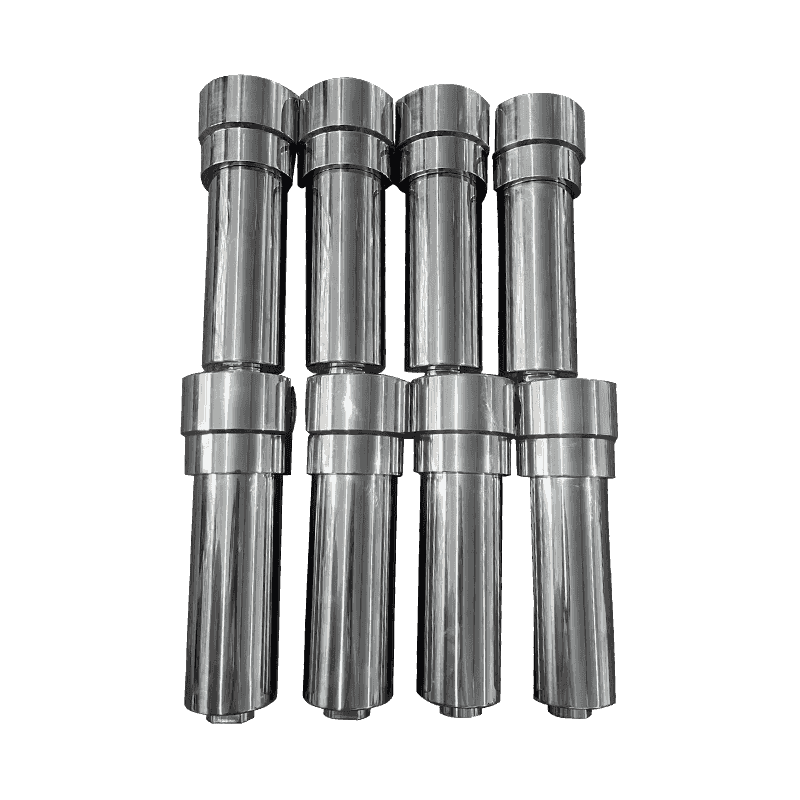
Filter element differential pressure should be monitored continuously rather than checked only during scheduled maintenance. A gradual rise in pressure drop across a coalescing stage indicates progressive oil and particulate loading, and replacing elements on a fixed calendar interval without reference to actual loading data either wastes filter life or, worse, allows a saturated element to pass contaminant downstream before the calendar date arrives.
Filtration alone does not solve the moisture problem. Compressed air leaving an aftercooler is still saturated with water vapor relative to its temperature and pressure, and as that air cools further while traveling through distribution piping, condensate forms inside the pipe network itself, well downstream of any point-of-use filter. This condensate collects in low points, dead legs, and unused branch connections, creating stagnant water reservoirs that are difficult to inspect and are a documented source of intermittent microbial contamination in finished product testing.
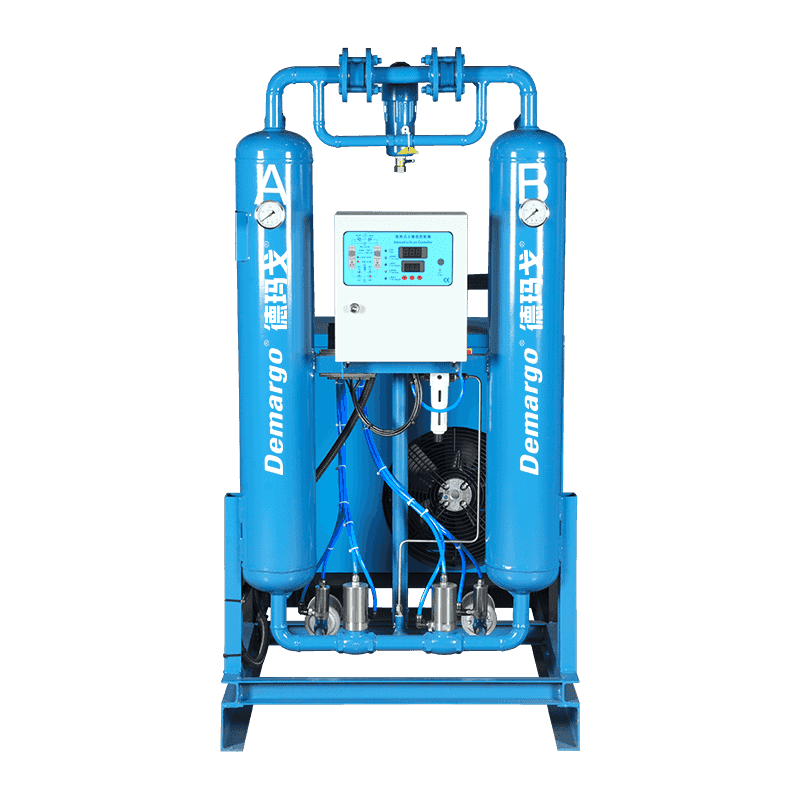
A combined low dew point compressed air dryer addresses this at the source by lowering the pressure dew point of the air before it enters distribution piping, so that condensation cannot form under normal ambient temperature swings. Combining refrigerant and desiccant drying stages in a single unit allows processors to hit dew point targets that neither technology reaches economically on its own, which matters for facilities running powder conveying or cold-chain pneumatic actuation where a single condensation event can trigger caking, line blockage, or a hygiene deviation.
Not every point in a facility needs the same filtration intensity. Matching filter grade to actual product exposure prevents both under-protection at critical points and unnecessary pressure drop or cost at points where the risk does not justify it.
| Zone Type | Recommended Filtration | Verification Frequency |
|---|---|---|
| Open product contact (dough injection, direct spray) | Coalescing plus carbon adsorption, Class 1 oil | Continuous differential pressure monitoring, quarterly lab testing |
| Packaging line actuation near open product | Coalescing filtration, Class 2 oil | Monthly visual and differential pressure check |
| Powder or granule pneumatic conveying | Particulate filtration plus low dew point drying | Continuous dew point monitoring |
| General plant utility air, non-contact | Standard particulate pre-filtration | Scheduled element replacement per manufacturer interval |
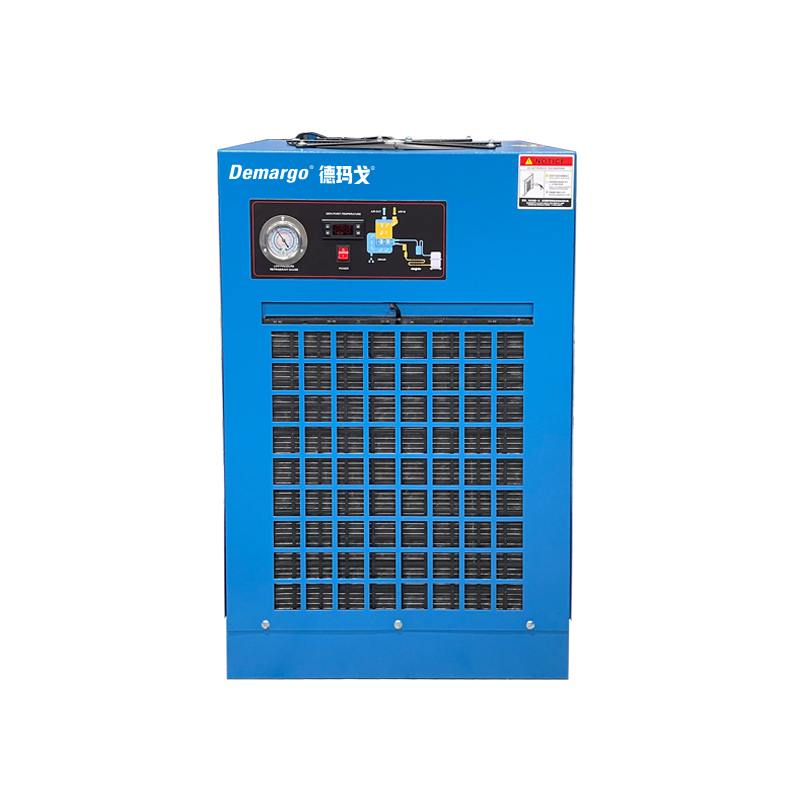
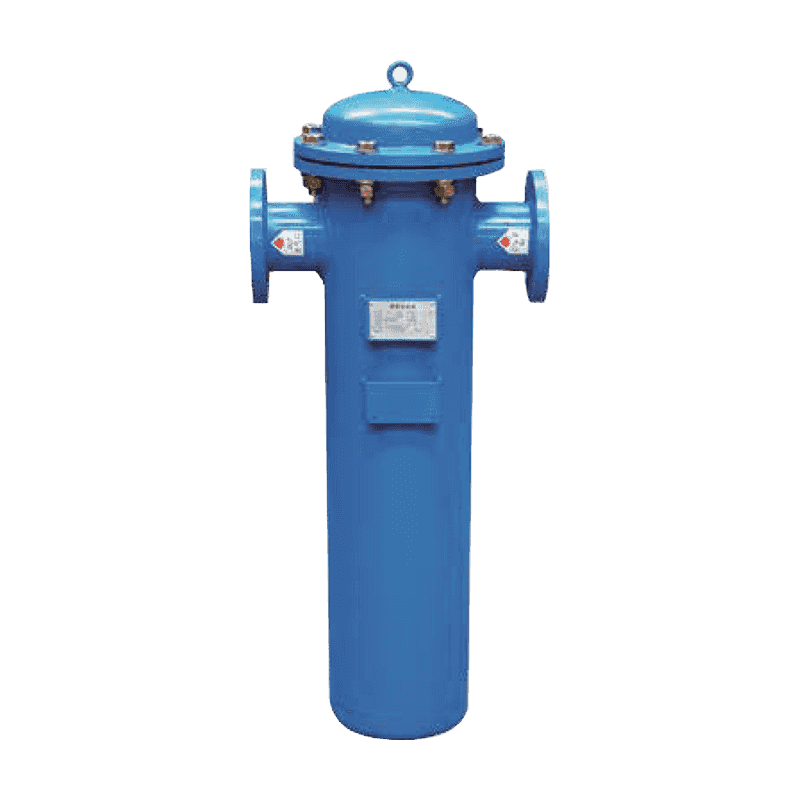
A general-purpose compressed air filter installed as the first line of defense after the receiver tank protects every downstream stage from bulk particulate loading, extending the service life of the finer coalescing and adsorption elements that follow it. Skipping this stage does not eliminate the need for fine filtration downstream, it simply shifts the loading burden onto more expensive elements and shortens their replacement cycle.
Air used for dough conditioning, pan release, and product blow-off requires low oil carryover and consistent dryness to avoid surface stickiness or localized mold growth on finished baked goods during shelf life.
Aseptic filling lines are especially sensitive to microbial contamination introduced through compressed air used for container blow-off or valve actuation adjacent to the fill head, making dew point and filtration verification a routine part of line startup checks.
Carbonation and bottle rinsing operations depend on air quality to avoid introducing off-flavors or particulate into the final product, particularly in operations without a downstream pasteurization step.
High-humidity wash-down environments accelerate corrosion in standard filter housings, making corrosion-resistant materials and moisture control equally important for equipment longevity and product safety.
An air treatment system specified correctly on day one will still fail an audit, and eventually fail a contamination investigation, if it is not maintained and verified on a documented schedule. The most common gap found during food safety audits is not undersized equipment, it is missing or inconsistent verification records.
Facilities that treat this as a living program, with records reviewed at a management level rather than filed and forgotten, consistently show fewer air-related findings during third-party audits and fewer unexplained microbial excursions in finished product testing.
A practical way to keep the program from drifting is to assign a single named owner for the compressed air quality plan, even though the physical maintenance work may be split across several roles. That owner is responsible for keeping the risk assessment current whenever a line changes, ensuring verification data is actually reviewed rather than only collected, and acting as the point of contact during audits. Facilities without a named owner tend to see the program function well immediately after an audit finding and then quietly lapse over the following year, only to resurface as a repeat finding at the next review.
Where treatment equipment sits relative to the point of use affects performance as much as the equipment specification itself. Installing a dryer and filtration train immediately after the compressor room, then routing long, uninsulated pipe runs across a warehouse to reach a filling line, gives ambient temperature swings room to reintroduce condensation before the air ever reaches the product. This is a common design oversight in facilities that were originally built for general manufacturing and later converted to food production without revisiting the utility layout.
| Design Factor | Risk If Ignored | Mitigation |
|---|---|---|
| Long uninsulated distribution runs | Condensation re-forms after drying, before reaching point of use | Insulate piping or add point-of-use filtration near the final application |
| Unused branch lines and dead legs | Stagnant condensate and biofilm accumulation | Cap or remove unused branches, schedule periodic drainage |
| Shared air supply across product and non-product zones | Non-critical demand spikes affect pressure and quality at critical points | Segregate critical zones onto a dedicated, independently monitored header |
| Filtration sized for original, not current, flow rate | Undersized elements load faster, shortening effective service life | Re-verify filtration sizing whenever compressor capacity or line count changes |
Segregating critical product zones onto their own header, sized and monitored independently from general plant air, is one of the highest-value changes a facility can make without replacing existing compressors. It isolates the purity requirements of sensitive applications from demand fluctuations elsewhere in the plant and makes the verification data for that zone much easier to interpret, since it is no longer mixed with usage patterns from unrelated equipment.
Most direct product contact applications target Class 1 for oil content, meaning oil carryover is reduced to the lowest practically measurable level. Indirect contact zones often use Class 2. The correct class depends on a documented risk assessment of how directly the air contacts exposed product.
Annual laboratory testing against the specified ISO class is a common baseline, with more frequent testing for open product contact zones. Continuous monitoring of differential pressure and dew point supplements periodic lab testing rather than replacing it.
Filters remove particulate and oil but do not remove water vapor. Moisture condenses further downstream inside distribution piping, creating conditions for microbial growth in locations a point-of-use filter cannot reach.
It is most important in wash-down zones and locations near open product, where corrosion risk and hygiene consequences are highest. General utility air away from product zones can often use standard housing materials without the same risk.
Standing condensate in low points, dead legs, or unused branch piping is a frequent cause. These reservoirs are downstream of the filtration train and are easy to overlook during routine inspection.
A single stage can reduce both to some degree, but dedicated coalescing and particulate stages in sequence achieve significantly better and more consistent results than relying on one combined element, particularly as elements load over time.

ADD: No. 9, Lane 38, Caoli Road, Fengjing Town, Jinshan District, Shanghai, China
Tel: 0086-17321147609
Email: [email protected]
Copyright © Demargo (Shanghai) Energy Saving Technology Co., Ltd. Rights Reserved. Custom Gas Purifiers Factory