INQUIRE NOW
Demargo (Shanghai) Energy Saving Technology Co., Ltd.
2024-12-17The difference between a refrigerated air dryer and an adsorption dryer?
2024-12-17Principle and application of modular dryer?
2024-12-17Precautions for using refrigerated air dryers?
2024-12-17Exploring the secrets of future food preservation: Entering the world of high-efficiency freeze-drying technology - refrigerated air dryer
2025-02-20Content
In industrial and commercial compressed air systems, moisture control is an essential component of system reliability, product quality, and operational safety. Moisture in compressed air lines can cause corrosion, tooling damage, process defects, microbial growth, and increased maintenance. Two primary types of dryers dominate moisture removal technologies: refrigerated air dryers and desiccant air dryers. While these are often presented as product choices, a systematic engineering evaluation goes beyond product features and considers system requirements, environmental conditions, process sensitivity, and life‑cycle costs.
Compressed air is widely used across industries including power generation, food processing, pharmaceuticals, electronics, petrochemicals, and automotive manufacturing. In most applications, water vapor is a by‑product of air compression due to air’s high humidity and thermodynamic effects of compression. When humid air is compressed, its temperature rises; on cooling, the vapor condenses. If not removed, this condensation becomes liquid water in pipelines and equipment.
Air dryers are installed downstream of compressors to reduce air moisture content to a level appropriate for a given application. Moisture removal technologies vary based on operation principle, dew point performance, energy consumption, footprint, maintenance requirements, and environmental conditions.
The two dominant dryer technologies are:
This paper systematically compares these technologies, clarifies their operating principles, application domains, design considerations, and presents guidelines for choosing between them.
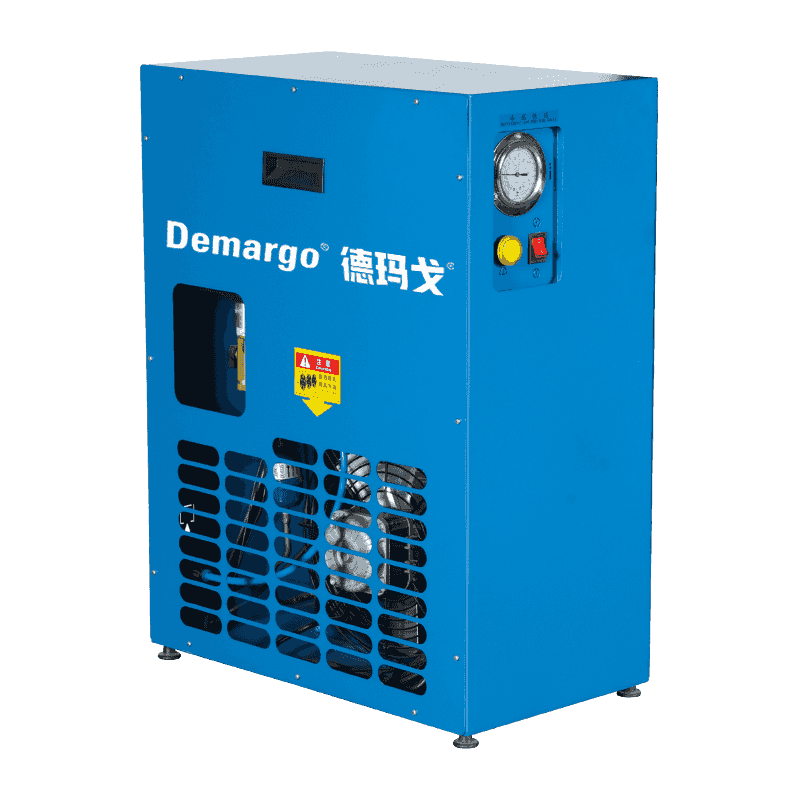
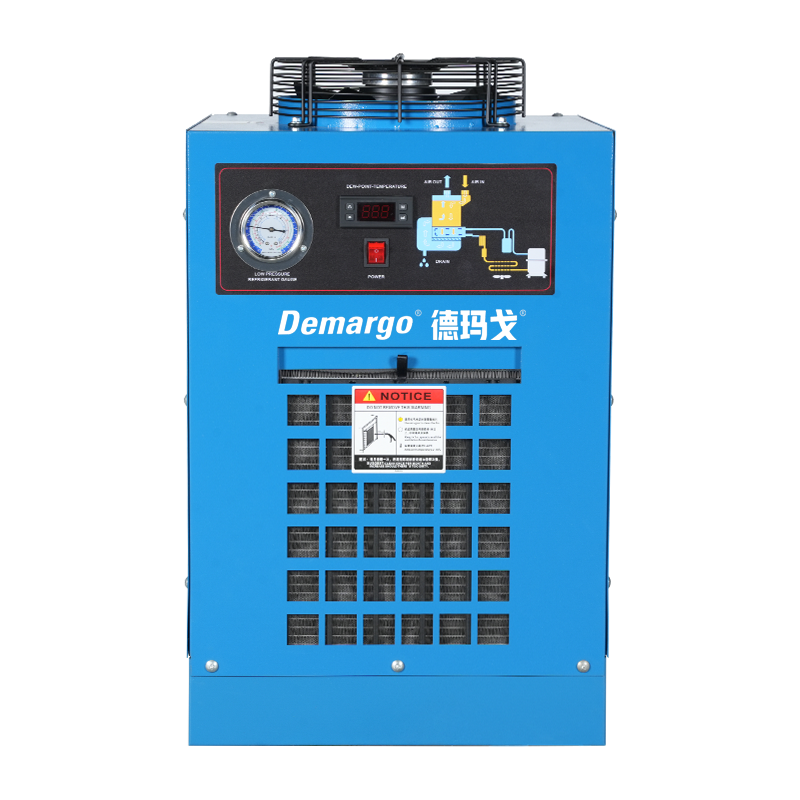
Refrigerated dryers operate on the principle of cooling compressed air to a temperature at which water vapor condenses (the dew point) and can be separated and drained. A typical refrigerated dryer uses a refrigeration cycle with a compressor, condenser, expansion valve, and evaporator to achieve cooling.
In a system perspective:
Key characteristics of refrigerated dryers:
Desiccant dryers operate by adsorbing moisture onto solid materials with high affinity for water vapor. Typical desiccants include activated alumina, silica gel, and molecular sieves. These dryers can achieve much lower dew points than refrigeration, often down to –40°C, –70°C, or lower.
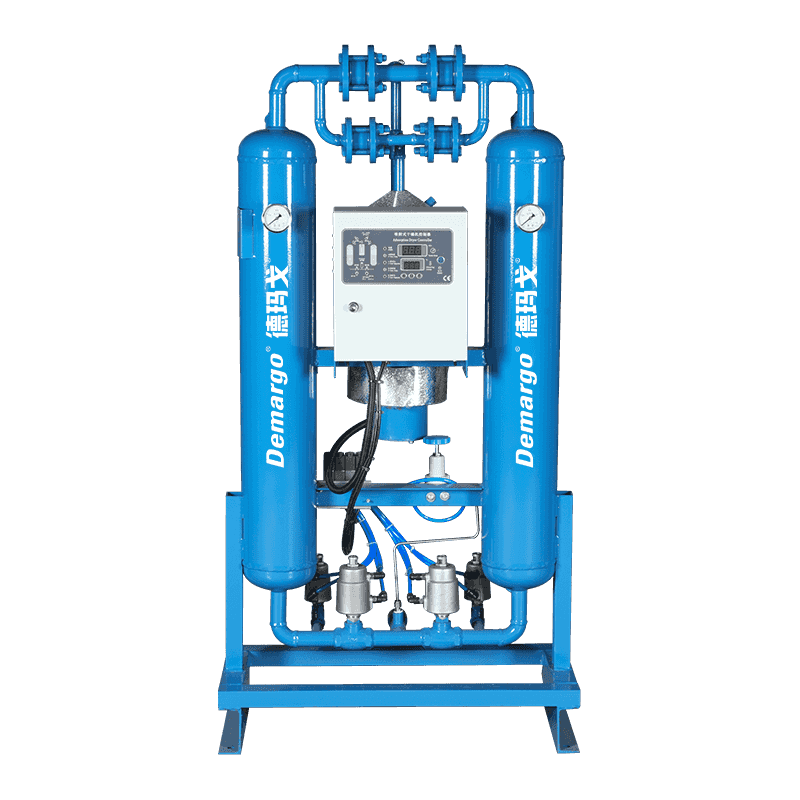
In a typical dual‑tower desiccant dryer:
Key characteristics of desiccant dryers:
To select the appropriate dryer technology, engineers must evaluate multiple performance dimensions. Table 1 summarizes key performance indicators for refrigerated and desiccant dryers.
Table 1. Comparative Performance Metrics
| Attribute | Refrigerated Air Dryers | Desiccant Air Dryers |
|---|---|---|
| Typical Dew Point Range | +2°C to +10°C | –40°C to –70°C (and lower) |
| Moisture Removal Mechanism | Condensation via cooling | Adsorption onto desiccant media |
| Energy Consumption | Moderate | Higher (due to regeneration or purge) |
| Maintenance Complexity | Lower | Higher (desiccant replacement/regeneration) |
| Initial Cost | Lower | Higher |
| Footprint | Compact | Larger (due to twin towers/regeneration) |
| Process Sensitivity Suitability | Moderate | High (critical processes) |
| Ambient Temperature Sensitivity | Affected at high ambient temperatures | Less sensitive |
| Pressure Dew Point Stability | Stable within design | Can be highly stable with control |
Refrigerated dryers are fundamentally limited by refrigeration capacity and heat transfer characteristics. They reduce moisture to a level where water condenses at the cooling temperature. While this level suffices for many manufacturing and general‑purpose applications, it may not meet the requirements of sensitive instrumentation, precision coating, or low‑temperature operations.
Desiccant dryers, on the other hand, achieve lower dew points by molecular adsorption, independent of condensation temperature. This enables extremely dry air, critical for applications like instrument air, paint booths, freeze‑point sensitive processes, and certain laboratory environments.
From a systems engineering perspective, energy efficiency must be evaluated over the full operational cycle.
Therefore, while desiccant dryers can achieve superior dew points, their energy cost per unit of dried air is typically higher than refrigerated dryers for equivalent flow rates.
Choosing between refrigerated and desiccant dryers requires an understanding of system requirements, environmental conditions, and process constraints. The following sections examine these in detail.
A chief determinant is the required pressure dew point for the application.
In cases where dew point must remain well below ambient, desiccant dryers become necessary.
Environmental conditions influence dryer performance:
Engineers must consider ambient profile, air inlet temperature, and pressure variation when selecting a dryer.
From a systems integration viewpoint, dryer selection affects:
Integration costs extend beyond purchase price to include engineering design, instrumentation, and commissioning.
To illustrate practical decision criteria, the following case scenarios reflect typical industrial contexts where dryer choice matters.
An automotive assembly facility uses compressed air for:
System Requirements:
Engineering Evaluation:
Conclusion: Refrigerated dryers are appropriate for general tooling applications where extremely low dew points are not necessary.
In a pharmaceutical process, compressed air feeds:
System Requirements:
Engineering Evaluation:
Conclusion: A desiccant air dryer system is justified due to stringent moisture control requirements.
An industrial cold storage facility has compressed air lines outdoors, exposed to sub‑zero temperatures.
System Requirements:
Engineering Evaluation:
Conclusion: Desiccant dryers are more reliable in this environment provided energy and maintenance budgets support them.
When selecting a dryer technology, engineers should address specific technical aspects beyond basic performance claims.
Dryers introduce pressure drop into compressed air systems. Excessive pressure drop increases compressor load and operational cost.
Design teams should evaluate:
Accurate dew point control and real‑time monitoring improve operational reliability:
Desiccant dryers often require more sophisticated control to manage regeneration cycles and purge flows.
Efficient removal of condensed water is critical, especially in refrigerated dryers:
For desiccant dryers:
Dryer maintenance affects lifecycle cost and reliability:
Engineering teams should plan preventive maintenance schedules based on operating hours, load cycles, and environmental factors.
Selecting a dryer is not solely about purchase price. A comprehensive selection process considers life‑cycle cost (LCC), which includes:
Refrigerated dryers generally have lower initial cost compared to desiccant systems, but this must be viewed in context of capacity, control systems, and integration costs.
The cost of process failure due to inadequate moisture control can far exceed the cost of selecting appropriate drying technology. System engineering must account for risk mitigation value of moisture control.
Engineering teams occasionally consider hybrid or staged drying approaches to balance performance and efficiency:
Such configurations require careful control logic and system integration planning.
For engineering, procurement, and system integration teams, the following process helps ensure selection aligns with system objectives:
Choosing between refrigerated and desiccant air dryers requires a systems engineering mindset. Refrigerated dryers are appropriate for many general‑purpose applications where moderate dew points suffice. Desiccant dryers are essential for high‑precision, moisture‑sensitive processes and environments with extreme ambient conditions. Engineers must consider dew point requirements, environmental conditions, energy and lifecycle costs, system integration complexity, and maintenance implications. Through a structured evaluation, compressed air systems can be designed to balance performance, reliability, and cost.
Q1: What is the primary difference between refrigerated and desiccant dryers?
A: Refrigerated dryers cool compressed air to condense moisture, achieving moderate dew points. Desiccant dryers use hygroscopic media to adsorb moisture, achieving much lower dew points. The selection depends on required dryness level and system conditions.
Q2: Can refrigerated dryers work in cold environments?
A: Refrigerated dryers may struggle in cold environments due to limitations in cooling capacity and risk of freezing. In such cases, desiccant dryers often perform better since they are less dependent on ambient temperature.
Q3: Why are low dew points important in some applications?
A: Low dew points prevent condensation in pipelines and equipment, protect sensitive instruments, enhance product quality in coatings, and prevent microbiological growth in processes such as food or pharmaceutical manufacturing.
Q4: Do desiccant dryers require more maintenance than refrigerated dryers?
A: Yes. Desiccant dryers typically require scheduled media changes, regeneration assessments, and control system checks. Refrigerated dryers have simpler maintenance focused on refrigeration components and drains.
Q5: How should engineers compare lifecycle costs of dryers?
A: Engineers should evaluate CAPEX, energy consumption, maintenance expenses, operating conditions, and impact on production uptime. A total cost of ownership model reveals long‑term cost differences.
Related Products

ADD: No. 9, Lane 38, Caoli Road, Fengjing Town, Jinshan District, Shanghai, China
Tel: 0086-17321147609
Email: [email protected]
Copyright © Demargo (Shanghai) Energy Saving Technology Co., Ltd. Rights Reserved. Custom Gas Purifiers Factory