INQUIRE NOW
Demargo (Shanghai) Energy Saving Technology Co., Ltd.
2024-12-17The difference between a refrigerated air dryer and an adsorption dryer?
2024-12-17Principle and application of modular dryer?
2024-12-17Precautions for using refrigerated air dryers?
2024-12-17Exploring the secrets of future food preservation: Entering the world of high-efficiency freeze-drying technology - refrigerated air dryer
2025-02-20Content
In modern industrial applications, the need for dry compressed air has become critical for maintaining product quality, equipment reliability, and operational efficiency. Two prominent technologies in the drying process are compression heat zero gas consumption adsorption dryer and regenerative dryers.
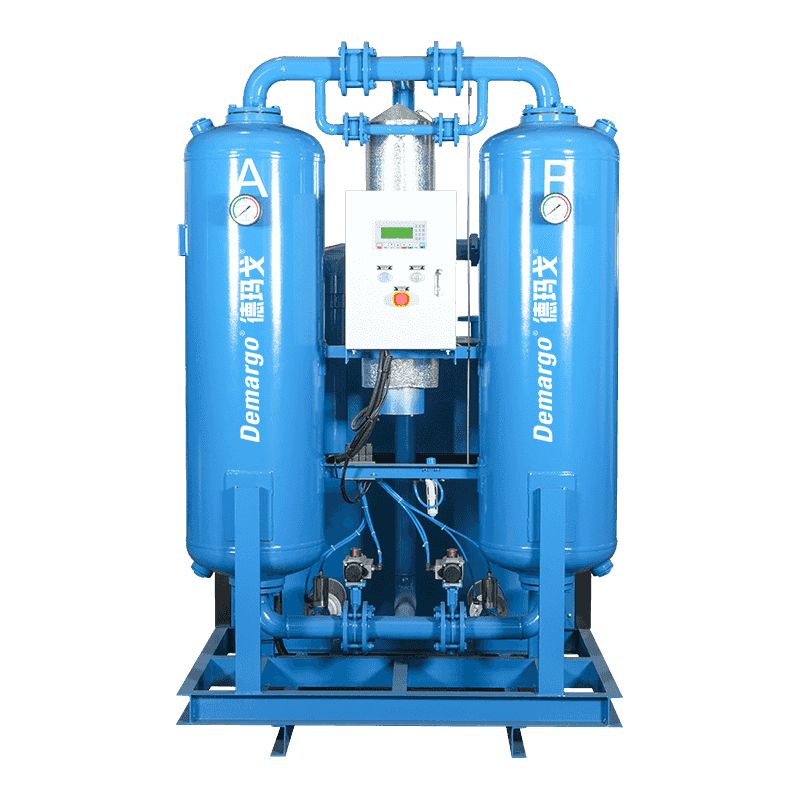
A compression heat zero gas consumption adsorption dryer relies on the principle of adsorption, where moisture from compressed air is captured on the surface of a desiccant material. The term “compression heat zero gas consumption” indicates that the dryer uses the heat generated by compression to regenerate the desiccant without consuming additional purge air, achieving zero gas consumption.
The system typically operates with two towers filled with desiccant material. While one tower is drying compressed air, the other undergoes regeneration. Heat generated from the compression process elevates the desiccant temperature, driving off adsorbed moisture. This process eliminates the need for external heat sources or significant compressed air consumption during regeneration, which is a key feature distinguishing this technology from conventional systems.
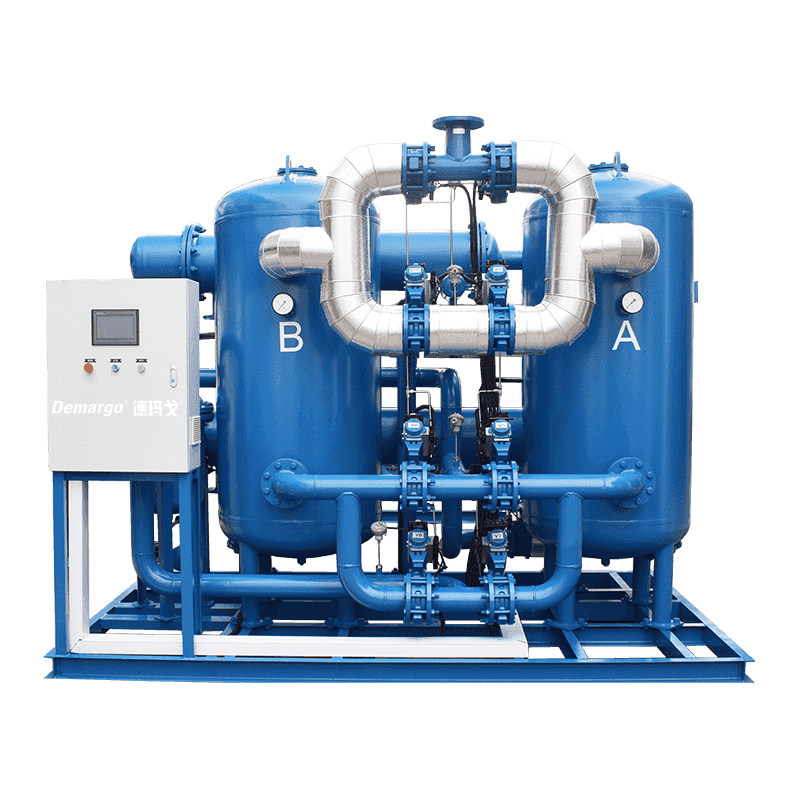
A regenerative dryer, often referred to as a heatless or heated desiccant dryer, also operates on the adsorption principle. However, its regeneration process differs significantly.
Both types rely on alternating cycles between drying and regeneration, but unlike compression heat zero gas consumption adsorption dryer, they cannot fully recover or utilize compression heat for regeneration, leading to higher operational costs.
| Feature | Compression Heat Zero Gas Consumption Adsorption Dryer | Regenerative Dryer |
|---|---|---|
| Desiccant regeneration | Uses compression heat, no purge air required | Uses purge air or external heater |
| Energy consumption | Lower due to zero gas consumption | Higher due to purge air or heater energy |
| Operational efficiency | Continuous operation with optimized regeneration | May experience reduced efficiency due to airflow loss during purge |
| Complexity | Requires heat management from compression | Simpler in design but higher running cost |
| Maintenance | Requires monitoring of heat recovery system | Regular desiccant replacement and heater maintenance |
From this table, it is evident that compression heat zero gas consumption adsorption dryer prioritizes energy efficiency and resource conservation, while regenerative dryers focus on simpler mechanical design and flexibility.
Both dryer types achieve low dew points suitable for industrial applications. Compression heat zero gas consumption adsorption dryer can consistently maintain dew points below -40°C, making it suitable for sensitive processes such as PET production, electronics manufacturing, and pharmaceutical applications.
Regenerative dryers also achieve comparable dew points but may exhibit fluctuations during purge cycles, particularly in heatless models. Heated regenerative dryers can maintain stable dew points but at the cost of additional energy consumption.
Compression heat zero gas consumption adsorption dryer utilizes compression heat for regeneration, reducing the need for purge air or external heating. This feature significantly improves overall energy efficiency. By contrast, regenerative dryers—especially heatless variants—consume a substantial portion of compressed air for regeneration, resulting in increased operational costs.
| Dryer Type | Energy Consumption | Compressed Air Loss | Operational Cost |
|---|---|---|---|
| Compression Heat Zero Gas Consumption Adsorption Dryer | Low | Minimal | Moderate to low |
| Heatless Regenerative Dryer | Moderate | 15–20% airflow | Moderate to high |
| Heated Regenerative Dryer | High | None | High |
These comparisons emphasize the importance of evaluating energy efficiency and compressed air conservation when selecting a drying solution for industrial operations.
Due to its high efficiency, low energy consumption, and stable dew point performance, the compression heat zero gas consumption adsorption dryer is widely applied in sectors where air quality is critical:
Regenerative dryers remain popular in industries where capital cost constraints or simpler system integration are priorities:
The choice between these systems depends on balancing energy efficiency, air quality requirements, and operational cost considerations.
Maintenance primarily focuses on:
Routine preventive maintenance ensures long-term performance stability and minimizes downtime.
Maintenance tasks include:
These tasks are generally more frequent due to air loss and external heater wear.
The compression heat zero gas consumption adsorption dryer offers significant environmental benefits by reducing energy usage and minimizing compressed air waste. Operational savings arise from lower electricity bills and reduced wear on air compressors.
Regenerative dryers, while effective, involve higher energy consumption and compressed air loss, which can impact both operating costs and sustainability goals.
In summary, while both compression heat zero gas consumption adsorption dryer and regenerative dryers achieve the goal of producing dry compressed air, the differences lie primarily in:
Selecting the appropriate system depends on application requirements, energy efficiency priorities, and long-term operational considerations. For industries where air quality and energy savings are critical, compression heat zero gas consumption adsorption dryer represents a superior solution.
Q1: Can a compression heat zero gas consumption adsorption dryer achieve lower dew points than regenerative dryers?
Yes, it can maintain consistently low dew points, often below -40°C, without the fluctuations associated with purge air cycles in regenerative dryers.
Q2: Are compression heat zero gas consumption adsorption dryers more cost-effective in the long term?
Yes, despite higher initial investment, the energy savings and reduced compressed air consumption lead to lower total operational costs.
Q3: What industries benefit most from compression heat zero gas consumption adsorption dryers?
Industries such as PET manufacturing, pharmaceuticals, electronics, and semiconductors benefit from the stable, dry air provided by these systems.
Q4: How often should maintenance be performed on a compression heat zero gas consumption adsorption dryer?
Routine inspections of desiccant condition, heat recovery efficiency, and tower switching should be performed regularly, typically every 6–12 months, depending on operating conditions.
Q5: Can regenerative dryers be upgraded to compression heat zero gas consumption adsorption dryers?
While direct conversion is usually not possible, facilities can replace regenerative dryers with compression heat zero gas consumption adsorption systems to achieve energy efficiency improvements.
Related Products

ADD: No. 9, Lane 38, Caoli Road, Fengjing Town, Jinshan District, Shanghai, China
Tel: 0086-17321147609
Email: [email protected]
Copyright © Demargo (Shanghai) Energy Saving Technology Co., Ltd. Rights Reserved. Custom Gas Purifiers Factory