Demargo (Shanghai) Energy Saving Technology Co., Ltd.
2024-12-17The difference between a refrigerated air dryer and an adsorption dryer?
2024-12-17Principle and application of modular dryer?
2024-12-17Precautions for using refrigerated air dryers?
2024-12-17Exploring the secrets of future food preservation: Entering the world of high-efficiency freeze-drying technology - refrigerated air dryer
2025-02-20Content
Three CNC lathes, one 30 kW rotary screw compressor, and a refrigerated dryer chosen by copying the compressor's flow figure straight from the datasheet. Six months later, maintenance was still draining water traps twice a shift and replacing sticking pneumatic valves, while the compressor itself performed exactly as rated. The equipment was fine. The sizing around it was not.
Air compressor sizing is a system calculation, not a catalog comparison. Four numbers decide whether an installation runs reliably: the real air demand, the working pressure band, the pressure dew point the process actually needs, and the ambient and inlet conditions where the equipment will sit. Compressor type, dryer technology, receiver volume and pipe diameter all follow from those four.
The order matters as much as the numbers. Demand is calculated first, pressure and storage second, air treatment third, and distribution last, because every step inherits the allowances of the step before it.
Start at the point of use, not in the compressor room. List every air consumer, read the manufacturer's flow figure at the actual working pressure, and add them up. A single 1 in. impact wrench can draw 25 CFM, which is more than three CNC machines combined.
| Air consumer | Typical demand (CFM at 90 psig) |
|---|---|
| 1/2 in. impact wrench | 4 - 5 |
| 1 in. impact wrench | 22 - 30 |
| Handheld plasma cutter | 5 - 7 |
| Powder coating gun | 10 - 15 |
| Safety blow gun, 1/4 in. nozzle | 10 - 15 |
| 1 in. diaphragm pump | 20 - 30 |
| Sandblast nozzle, 3/16 in. | 25 - 35 |
| CNC machine, average including tool change | 1 - 3 |
Very few plants run every consumer at the same moment, so apply a simultaneity factor: close to 1.0 for continuous duty such as packaging lines or pneumatic conveying, and closer to 0.6 for intermittent hand-tool work in a workshop.
Then add leakage, which is the largest invisible load in most systems. A plant with an active leak survey typically carries 10 to 15 percent; a plant without one commonly runs 20 to 30 percent. At 100 psig, a 1/16 in. opening passes roughly 6 CFM, and a 1/4 in. opening passes around 100 CFM.
Finish with a growth allowance of 15 to 25 percent for the next five years, and confirm that the compressor figure you are comparing against is free air delivery rather than displacement. The two differ by 10 to 20 percent on screw and piston machines, and mixing them up is one of the most common causes of an undersized system.
Work backwards from the point of use. Take the highest pressure any tool or process needs, add the losses across dryers, filters, separators and piping, and the result is the required compressor discharge pressure. A practical budget keeps total drop at or below 10 percent of discharge pressure, which at 100 psig means about 10 psi in total and roughly 1 to 3 psi per component.
Storage is what converts an intermittent demand spike into a steady load on the compressor. Too little receiver volume and the machine short-cycles, which costs energy, heats the oil and shortens the life of the load/unload valve. Too much storage wastes floor space and money, but the penalty for undersizing is usually paid every day.
A receiver does not make air. It only decides how often the compressor has to start making more of it.
Size the receiver against the largest short-term event in the plant, such as a valve bank firing or a blow-off cycle, not against the average hourly flow. If that event lasts 10 seconds and draws 50 CFM above the compressor's output, the receiver and the pressure band must cover those 10 seconds without letting header pressure fall below the lowest acceptable working level.
Dryer capacity is published at reference conditions, typically 100 °F inlet air, 100 °F ambient, 100 psig and a 38 °F pressure dew point under ISO 7183. Move away from that reference and usable capacity falls quickly.
| Inlet air temperature | Correction factor | Effective capacity of a 500 CFM dryer |
|---|---|---|
| 90 °F | 1.05 | 525 CFM |
| 100 °F | 1.00 | 500 CFM |
| 110 °F | 0.80 | 400 CFM |
| 120 °F | 0.65 | 325 CFM |
A 500 CFM dryer fed with 120 °F air from a marginal aftercooler behaves like a 325 CFM unit. Put it behind a 400 CFM compressor and the plant is short of drying capacity from the first shift, which is exactly the situation in the opening example. Cool the air and remove bulk condensate before the dryer inlet, then size the dryer on the corrected figure rather than on the compressor nameplate.
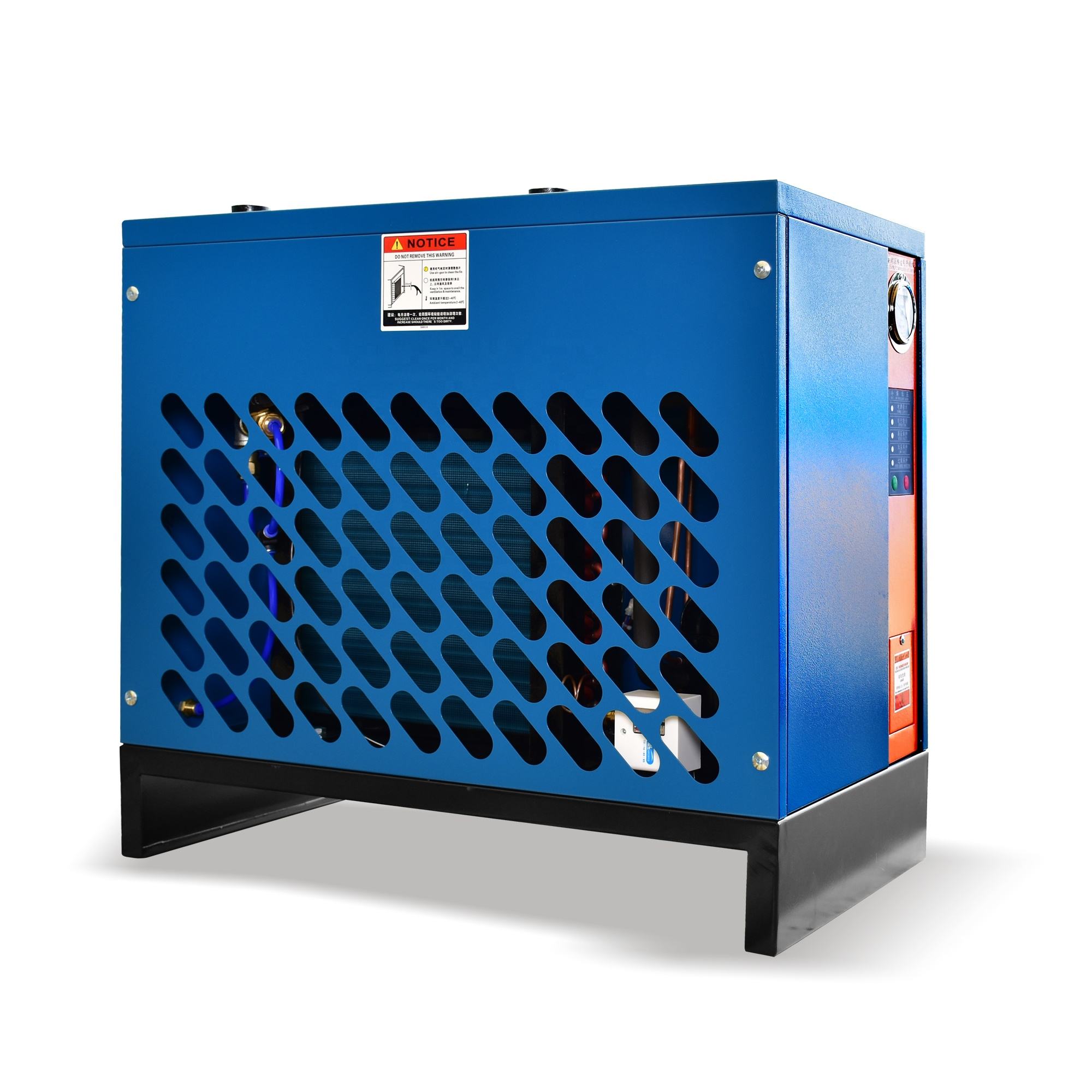
For a mid-size plant compressor in the 400 CFM class, a refrigerated dryer matched to the corrected flow is the standard baseline for indoor use.
Demargo 400 CFM Air-Cooling Refrigerated Compressor Air DryerFor 400 CFM compressor, this air-cooled refrigerated dryer is baseline indoor choice; verify pressure correction at 90 psig or lower.View Product →
Dryer ratings are tied to inlet pressure. Lower pressure means higher actual volumetric flow through the same heat exchanger, so a dryer rated at 100 psig loses capacity at 80 psig. Any system running at 90 psig or below should be checked against the manufacturer's pressure correction table before the model is confirmed.
A refrigerated dryer holds roughly a 38 °F (3 °C) pressure dew point, which satisfies ISO 8573-1 class 4 for water in most ratings. That is comfortable for indoor piping in a heated building, but not for exposed outdoor headers in winter, instrument air, or laser cutting optics where condensation damages parts.
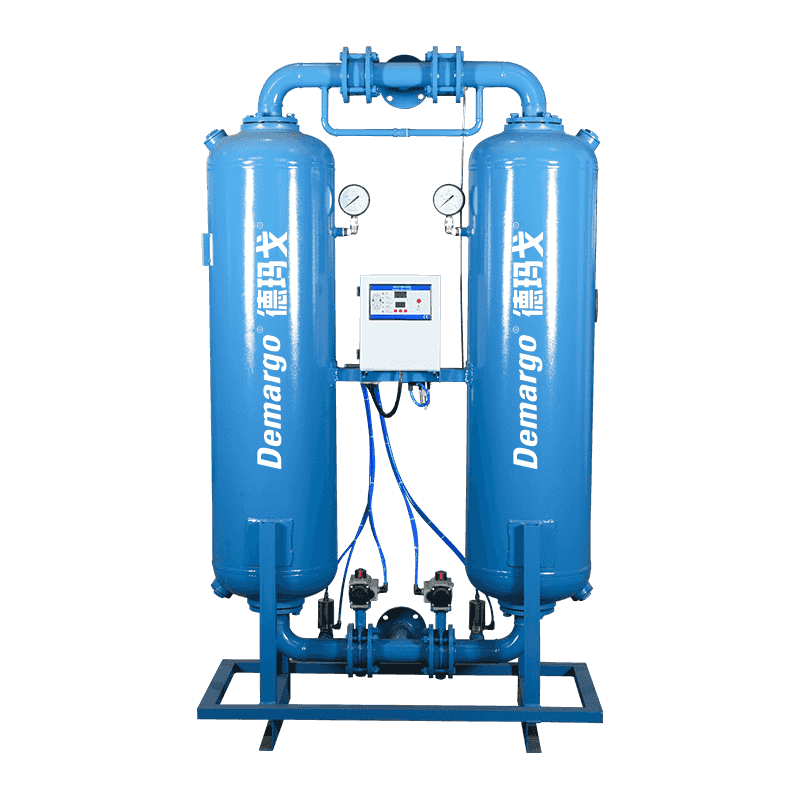
Desiccant dryers reach -40 °F (-40 °C) or lower, and their sizing includes one detail that is easy to miss: purge air. A heatless regenerative dryer uses roughly 12 to 18 percent of its rated flow to regenerate the offline tower, and that purge must be added to the compressor capacity instead of deducted from plant demand. A 300 CFM demand with a heatless dryer at 15 percent purge therefore needs about 345 CFM of compressor capacity.
Heatless Regeneration PSA Adsorption Compressed Air DryerFor -40°F dew point, this heatless regenerative dryer uses purge air; account for 12-18% purge when sizing compressor.View Product →
Inlet temperature sets the limit as well. Adsorption capacity drops sharply above 100 °F, which is why a refrigerated or blower-cooled pre-stage is almost always part of the sizing whenever a -40 °F dew point is specified.
Filters are flow devices, not accessories. A coalescing element selected by port size instead of by flow at operating pressure can drop 5 to 10 psi once it loads with oil aerosol and particulate, and the compressor then has to make up that loss with extra discharge pressure and extra energy.
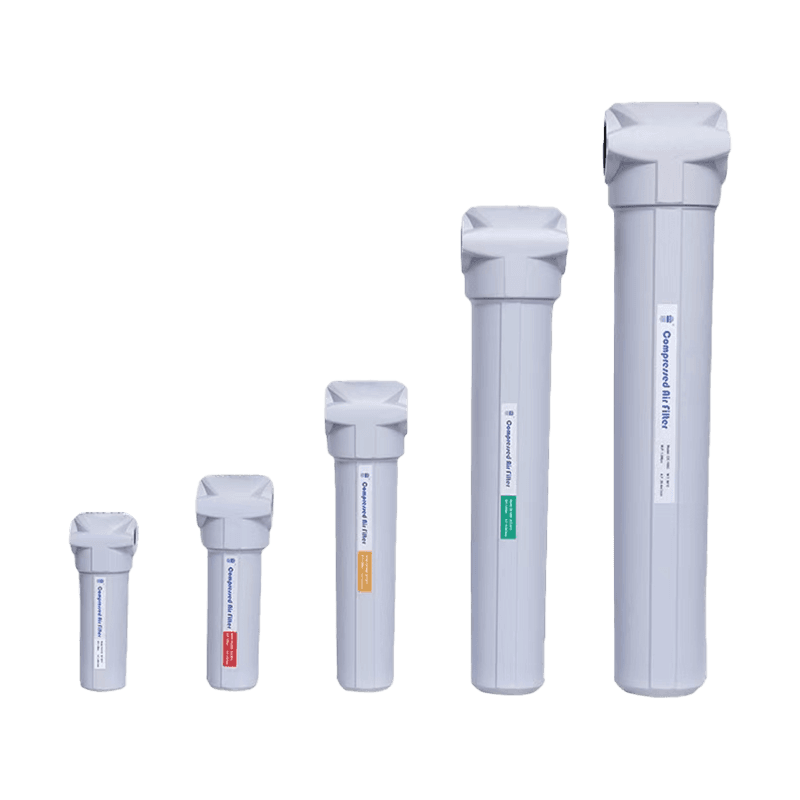
Clean differential pressure of 1 to 3 psi is normal for a correctly sized element. Anything above 10 psi usually means the housing is undersized, the element is overdue, or both. Grade filtration in series, with bulk water separation first, coalescing for oil mist second and a fine particulate stage last, and fit a differential pressure gauge so element changes follow data rather than a calendar.
E Series Precision Compressed Air Impurity Removal FilterFor staged filtration, this precision filter removes oil, water, and dust; monitor differential pressure to know when to replace element.View Product →Header velocity is the practical limit: keeping mains and drops between 20 and 30 ft/s controls both pressure loss and noise. Ring mains hold velocity lower and pressure steadier than dead-end runs, and drops taken from the top of the header keep condensate in the main, where it can be drained.
An undersized header shows up as tools that stall the moment a second machine starts. That symptom looks like a compressor shortage, and it frequently leads to buying a larger compressor than the plant ever needed. Check the pipe schedule and the pressure drop budget before the compressor quote is signed.
A variable speed screw compressor trims flow smoothly between roughly 25 and 100 percent of capacity, which suits plants whose demand varies slowly. Below its minimum speed it must load and unload like any other machine, so storage still matters.
Where a plant has a steady base load and a peaky top end, base loading a fixed speed machine and using a smaller variable speed unit for trim usually beats one large variable speed compressor that spends most of its life cycling at the bottom of its range. Whichever strategy is chosen, keep the pressure band and receiver wide enough that the compressor does not start more than a few times an hour.
Add the flow of every consumer at its working pressure, apply a simultaneity factor of 0.6 to 1.0, add measured leakage of 10 to 30 percent, and add a 15 to 25 percent growth allowance. A week of logged data beats a single spot reading.
Only if the dryer's reference conditions match your installation. Correct the dryer capacity for inlet temperature, ambient temperature and working pressure first, then compare it with the compressor's free air delivery.
A common starting point is 3 to 5 gallons per CFM with a 10 psi load/unload band, so 300 to 500 gallons. Tighten the band to 5 psi and the requirement roughly doubles.
Yes. An oversized fixed speed machine unloads more often, which raises specific power consumption and cycling wear. Oversizing is only harmless when it is paired with adequate storage and a control strategy that suits the load.
Match it to the coldest point the piping passes through: 38 °F for indoor, heated plants, and -40 °F or lower for outdoor lines, instrument air or laser cutting. Every step below 38 °F adds regeneration energy.
A supplier can only size equipment against the operating conditions you provide. Six inputs are enough to work from: peak and average flow, minimum and maximum working pressure, required pressure dew point, ambient temperature range, site altitude, and daily running hours.
Datasheets, correction tables and technical documents for dryers, filters and drain systems are collected in the download section if you want to check the corrected capacity yourself before requesting a quote.
If the dew point requirement is still open, this guide to choosing the right compressed air dryer walks through the trade-offs between refrigerated and desiccant technology at the same flow.
Related Products
ADD: No. 9, Lane 38, Caoli Road, Fengjing Town, Jinshan District, Shanghai, China
Tel: 0086-17321147609
Email: [email protected]
Copyright © Demargo (Shanghai) Energy Saving Technology Co., Ltd. Rights Reserved. Privacy Custom Gas Purifiers Factory

English
русский
Español
عربى