INQUIRE NOW
Demargo (Shanghai) Energy Saving Technology Co., Ltd.
2024-12-17The difference between a refrigerated air dryer and an adsorption dryer?
2024-12-17Principle and application of modular dryer?
2024-12-17Precautions for using refrigerated air dryers?
2024-12-17Exploring the secrets of future food preservation: Entering the world of high-efficiency freeze-drying technology - refrigerated air dryer
2025-02-20Content
The demand for high-purity compressed air has increased significantly across industries such as pharmaceuticals, electronics, food processing, and PET bottle manufacturing. Maintaining consistent air quality is critical in these applications to prevent contamination, product defects, and equipment malfunction. Among the available drying technologies, the micro heat regeneration adsorption dryer has emerged as a reliable solution to ensure stable, high-purity compressed air.
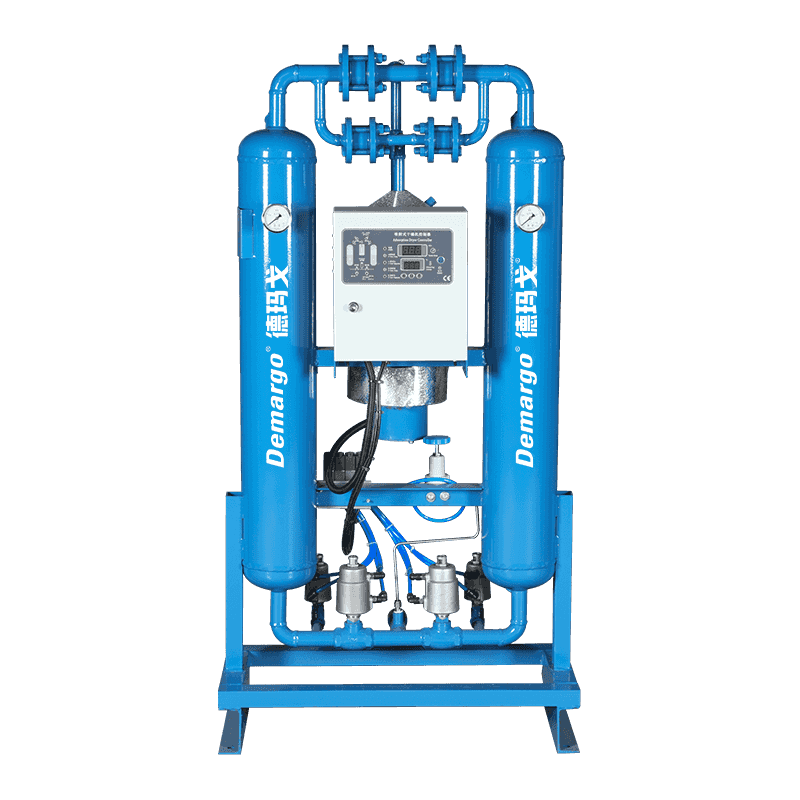
A micro heat regeneration adsorption dryer operates based on the principle of adsorption, in which moisture is removed from compressed air by passing it through a desiccant material. Unlike conventional heatless desiccant dryers, which rely solely on a portion of dried air for regeneration, micro heat regeneration adsorption dryer uses a small, controlled amount of heat to regenerate the desiccant, improving energy efficiency while maintaining a low dew point.
The operation involves two main stages:
The micro heat regeneration adsorption dryer is engineered to maintain continuous operation with minimal fluctuation in dew point, making it suitable for applications where high air purity is essential.
The use of micro heat regeneration adsorption dryer in high-purity compressed air systems offers several key benefits:
| Feature | Heatless Dryer | Heated Dryer | Micro Heat Regeneration Adsorption Dryer |
|---|---|---|---|
| Energy consumption | High | Moderate | Low |
| Dew point stability | Moderate | High | High |
| Desiccant lifespan | Short | Moderate | Long |
| Footprint | Large | Medium | Compact |
| Suitable for continuous operation | Limited | Yes | Yes |
The performance of micro heat regeneration adsorption dryer depends heavily on the choice of desiccant. Common desiccants include activated alumina, silica gel, and molecular sieves. Each offers specific advantages:
The selection process must consider operating temperature, compressed air pressure, desired dew point, and airflow requirements. Proper desiccant choice ensures the micro heat regeneration adsorption dryer consistently delivers high-purity air without frequent maintenance.
Designing a micro heat regeneration adsorption dryer system for high-purity compressed air involves several key considerations:
| Parameter | Typical Range | Notes |
|---|---|---|
| Operating pressure | 6–10 bar | Standard industrial compressed air systems |
| Dew point | -40°C to -70°C | Ultra-low dew point for critical applications |
| Regeneration air temperature | 120°C–150°C | Controlled to prevent desiccant damage |
| Airflow | As per system design | Must match production and demand requirements |
In pharmaceuticals, micro heat regeneration adsorption dryer ensures that compressed air used in packaging, filling, or instrument operation is free from moisture. High-purity air prevents bacterial growth and protects sensitive formulations, maintaining compliance with stringent regulatory standards.
Moisture in compressed air can negatively affect product quality and shelf life. Micro heat regeneration adsorption dryer provides consistent dry air for filling, aerosol spraying, and packaging operations, ensuring food safety and equipment longevity.
In electronics production, even minor moisture levels can cause corrosion or defects. Micro heat regeneration adsorption dryer maintains ultra-dry conditions in assembly areas, protecting components and improving production yield.
High-purity compressed air is critical in PET bottle blowing processes to prevent contamination and ensure uniform wall thickness. The micro heat regeneration adsorption dryer ensures reliable, moisture-free air supply for high-quality bottle production.
Maintaining the performance of micro heat regeneration adsorption dryer requires adherence to operational guidelines:
These practices ensure micro heat regeneration adsorption dryer provides reliable, high-purity compressed air while minimizing downtime and operational costs.
Modern micro heat regeneration adsorption dryer systems focus on energy efficiency through micro-heat regeneration, variable airflow, and automated control systems. Reduced energy consumption not only lowers operating costs but also supports sustainability initiatives in industrial facilities. Integrating the dryer with an energy management system allows operators to track consumption and optimize performance continuously.
For optimal results, micro heat regeneration adsorption dryer must be properly integrated into the compressed air network. Key integration considerations include:
Proper integration ensures high-purity compressed air throughout the production line without affecting system efficiency or reliability.
The development of micro heat regeneration adsorption dryer continues to focus on:
These trends enhance the reliability, energy efficiency, and operational flexibility of micro heat regeneration adsorption dryer systems in high-purity applications.
The micro heat regeneration adsorption dryer plays a vital role in supporting high-purity compressed air applications. Its ability to maintain a stable low dew point, combined with energy efficiency and operational reliability, makes it indispensable in industries such as pharmaceuticals, food processing, electronics, and PET bottle manufacturing. Through careful design, proper desiccant selection, and adherence to operational best practices, the micro heat regeneration adsorption dryer ensures that compressed air systems meet stringent quality requirements, supporting product integrity and industrial efficiency.
Q1: What is the typical dew point achievable by micro heat regeneration adsorption dryer?
A1: Most systems can achieve dew points as low as -40°C to -70°C, suitable for high-purity compressed air applications.
Q2: How often should the desiccant in micro heat regeneration adsorption dryer be replaced?
A2: Replacement intervals vary based on operating conditions, but a general recommendation is every 3–5 years, depending on load and air quality.
Q3: Can micro heat regeneration adsorption dryer be used for food-grade air systems?
A3: Yes, the dryer can maintain ultra-low moisture levels required for food and beverage applications, ensuring compliance with safety standards.
Q4: How does micro heat regeneration adsorption dryer reduce energy consumption?
A4: By using a small fraction of heated air for regeneration, energy use is minimized compared to traditional heatless dryers.
Q5: What maintenance steps are essential for optimal performance?
A5: Monitoring dew point, cleaning filters, checking for leaks, and periodic desiccant replacement are key for maintaining performance.
Related Products

ADD: No. 9, Lane 38, Caoli Road, Fengjing Town, Jinshan District, Shanghai, China
Tel: 0086-17321147609
Email: [email protected]
Copyright © Demargo (Shanghai) Energy Saving Technology Co., Ltd. Rights Reserved. Custom Gas Purifiers Factory