INQUIRE NOW
Demargo (Shanghai) Energy Saving Technology Co., Ltd.
2024-12-17The difference between a refrigerated air dryer and an adsorption dryer?
2024-12-17Principle and application of modular dryer?
2024-12-17Precautions for using refrigerated air dryers?
2024-12-17Exploring the secrets of future food preservation: Entering the world of high-efficiency freeze-drying technology - refrigerated air dryer
2025-02-20Content
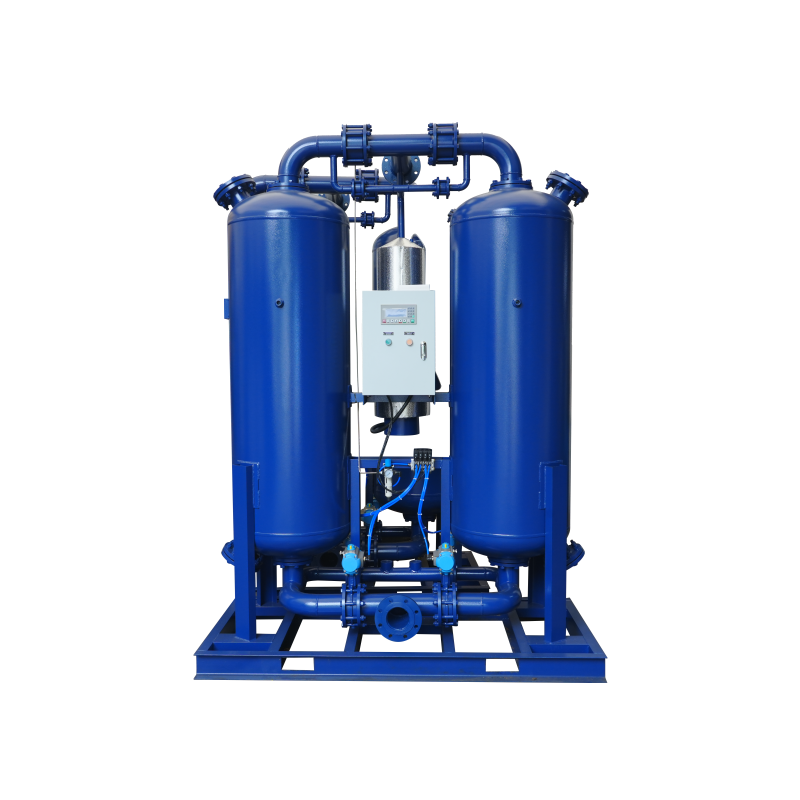
A heatless regenerative air dryer removes moisture from compressed air using desiccant material — without any external heat source. It achieves pressure dew points as low as -40°C (-40°F) or even -70°C (-94°F), making it one of the most reliable solutions for applications that demand ultra-dry air.
The core operating principle relies on two towers filled with desiccant (typically activated alumina or silica gel). While one tower dries the incoming compressed air, the other regenerates using a small portion of the already-dried air — typically around 15% of the total output flow. This alternating cycle runs continuously with no heat required, which is why it is classified as "heatless."
For industries such as pharmaceuticals, electronics manufacturing, food processing, and instrumentation, contamination from moisture can cause product defects, equipment failure, or safety hazards. A heatless regenerative dryer directly solves this problem with a simple, proven mechanism.
Understanding the operating cycle helps engineers and operators select the right system and troubleshoot issues efficiently. The process follows four key phases:
This cycle is fully automatic and continuous. No manual intervention is needed during normal operation, and the system can run 24/7 without downtime for regeneration.
These dryers are not general-purpose tools — they serve specific industries where moisture control is mission-critical. Below are the primary use cases:
In pharmaceutical manufacturing, compressed air often contacts raw materials, packaging, or finished products. Moisture contamination can degrade active ingredients or cause microbial growth. Pressure dew points of -40°C or lower are typically required to meet GMP (Good Manufacturing Practice) standards. Heatless dryers achieve this consistently without adding heat-related risk to the environment.
Moisture causes oxidation on circuit boards, solder joint failures, and static discharge issues. Cleanroom environments for chip fabrication or PCB assembly often mandate compressed air with dew points below -40°C. Heatless dryers provide this level of dryness without fluctuation.
Compressed air used for packaging, conveying, or direct contact with food must meet strict hygiene standards. Moisture promotes bacterial growth and shortens shelf life. A heatless system ensures dry, clean air delivery while avoiding the energy cost of heated alternatives in moderate-output facilities.
Pneumatic instruments, control valves, and analyzers are highly sensitive to moisture. Even small amounts of water can cause valve sticking, sensor drift, or corrosion in sensing lines. Heatless dryers protect these systems reliably, especially in outdoor or cold-climate installations where condensation risk is highest.
Laser cutting systems use compressed air to assist the cutting beam and eject debris. Moisture in this air stream can contaminate lenses, reduce cut quality, and damage expensive optical components. Dew points below -40°C are standard requirements for high-performance laser applications.
Both dryer types use desiccant, but their regeneration methods differ significantly. The table below summarizes the key differences to guide selection:
| Feature | Heatless Regenerative | Heated Regenerative |
|---|---|---|
| Regeneration Method | Purge air only (no heat) | External heater + purge air |
| Purge Air Loss | ~15% of output | ~2–8% of output |
| Energy Consumption | Lower (no heater) | Higher (heater power required) |
| Achievable Dew Point | -40°C to -70°C | -40°C to -70°C |
| Best For | Low to medium flow rates | High flow rates, energy-critical sites |
| Installation Complexity | Simple | Moderate (heater wiring required) |
| Maintenance | Lower (fewer components) | Higher (heater element upkeep) |
Heatless dryers are the preferred choice for flow rates under approximately 500 Nm³/h where installation simplicity and low maintenance outweigh the higher purge air cost. For large industrial compressor stations with high continuous demand, heated types may offer better efficiency.
A significant advancement in compressed air treatment is the integration of filtration and drying into a single compact unit. The Heatless Combined Compressed Air Dryer combines pre-filtration, desiccant drying, and after-filtration in one housing. This design reduces installation footprint, eliminates multiple connection points, and simplifies system maintenance.
Key advantages of the combined design include:
This integrated approach is particularly suitable for OEM machinery builders, laboratory gas systems, and decentralized point-of-use installations where space and simplicity are priorities.
Selecting the correct dryer is only part of the equation. Several operating conditions directly influence dew point performance and desiccant life:
Higher inlet temperatures reduce desiccant adsorption capacity. Most heatless dryers are rated at an inlet temperature of 35–40°C. If inlet air exceeds this (e.g., in hot climates without aftercooling), the achievable dew point degrades. An aftercooler and moisture separator upstream of the dryer are strongly recommended.
Oil vapor from lubricated compressors coats desiccant particles and permanently reduces their adsorption capacity. A coalescing pre-filter rated at 0.01 mg/m³ residual oil content should always be installed upstream. This is non-negotiable for maintaining dew point performance and desiccant service intervals.
Standard cycle times of 5 minutes per half-cycle (10-minute full cycle) are factory set. If switching valves wear or stick, one tower may not fully regenerate before it is switched back online, causing dew point spikes. Regular inspection of directional valves is a key maintenance task.
Operating a dryer at more than 100% of its rated flow causes breakthrough — where wet air passes through the desiccant bed faster than it can be adsorbed. Always select a dryer with a rated capacity at least 10–15% above actual demand to provide a safety margin under varying load conditions.
Heatless dryers have fewer moving parts than heated alternatives, but they still require scheduled maintenance to maintain performance. A typical maintenance plan includes:
With clean inlet conditions and proper pre-filtration, activated alumina desiccant typically lasts 3–5 years before requiring replacement. In environments with high oil carryover or high humidity, service intervals may be shorter.
Even a correctly specified dryer can underperform if installation is done improperly. The following errors are frequently observed in the field:
Standard units achieve -40°C (-40°F). High-performance models reach -70°C (-94°F). The exact dew point depends on correct sizing, inlet conditions, and proper pre-filtration.
Typically around 15% of the dryer's rated outlet flow. This purge air is used to regenerate the offline desiccant tower and is vented to atmosphere.
Yes, and it is ideal. Oil-free compressors eliminate the risk of desiccant fouling from oil contamination, extending desiccant life and reducing maintenance frequency.
Every 3–5 years under clean operating conditions. With oil contamination or high humidity inlet air, replacement may be needed sooner — sometimes within 1–2 years.
Yes, but ensure the unit is protected from direct rainfall, freezing temperatures (which can damage valves), and direct sunlight that raises ambient temperature. An enclosure or canopy is recommended in exposed environments.
A standard heatless dryer is the drying unit alone. A combined model integrates pre-filtration and after-filtration into the same housing, reducing connections, footprint, and installation time while providing full air treatment in one compact unit.
Yes. The two-tower alternating design allows 24/7 continuous operation. One tower is always online while the other regenerates, with no interruption to the air supply.
Related Products

ADD: No. 9, Lane 38, Caoli Road, Fengjing Town, Jinshan District, Shanghai, China
Tel: 0086-17321147609
Email: [email protected]
Copyright © Demargo (Shanghai) Energy Saving Technology Co., Ltd. Rights Reserved. Custom Gas Purifiers Factory