INQUIRE NOW
Content
Most compressed air quality conversations start with particle filtration and oil carryover, yet moisture is often the variable that determines whether a process succeeds or fails. Pressure dew point, commonly abbreviated PDP, describes the temperature at which water vapor inside a pressurized air line begins to condense. When PDP sits above the lowest ambient temperature a pipe network experiences, condensation forms inside the piping itself, not just at the point of use.
In moisture-sensitive manufacturing environments such as electronics assembly, pharmaceutical packaging, and precision instrument air supply, even a few degrees of PDP deviation can introduce enough residual moisture to compromise product quality. A single condensation event inside an air line can carry rust particles, standing water, or biological growth downstream into a pneumatic tool, a spray nozzle, or a sealed instrument housing.
This article looks at how drying technologies are layered together to reach dew points that a single-stage system cannot achieve on its own, and how that layering translates into measurable reliability gains for demanding applications.
Ambient air always carries water vapor, and compressing that air concentrates the moisture rather than removing it. A ratio of roughly seven to one is typical when air is compressed from atmospheric pressure to a standard working pressure, which means the same volume of water vapor is now packed into a much smaller space. Without treatment, that concentrated vapor condenses as soon as the air cools anywhere downstream, whether inside a pipe run, a filter housing, or a tool.
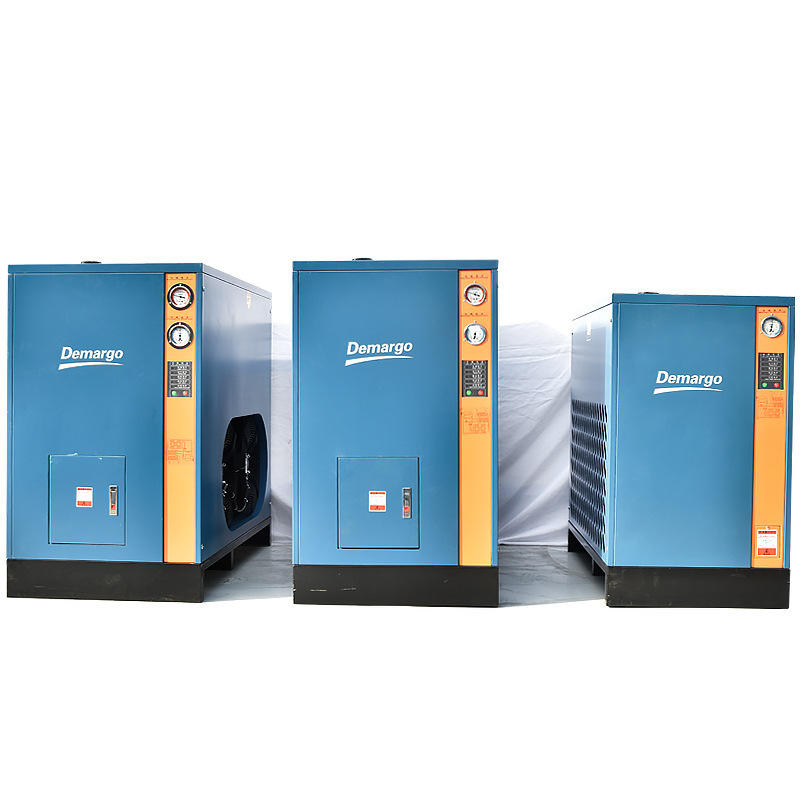
The baseline function of any drying stage is to bring the pressure dew point down below the lowest temperature the air will encounter after leaving the dryer. Refrigerated-style drying stages typically target a pressure dew point in the range of three to ten degrees Celsius, which is sufficient for general workshop air, pneumatic tools, and most outdoor piping in temperate climates.
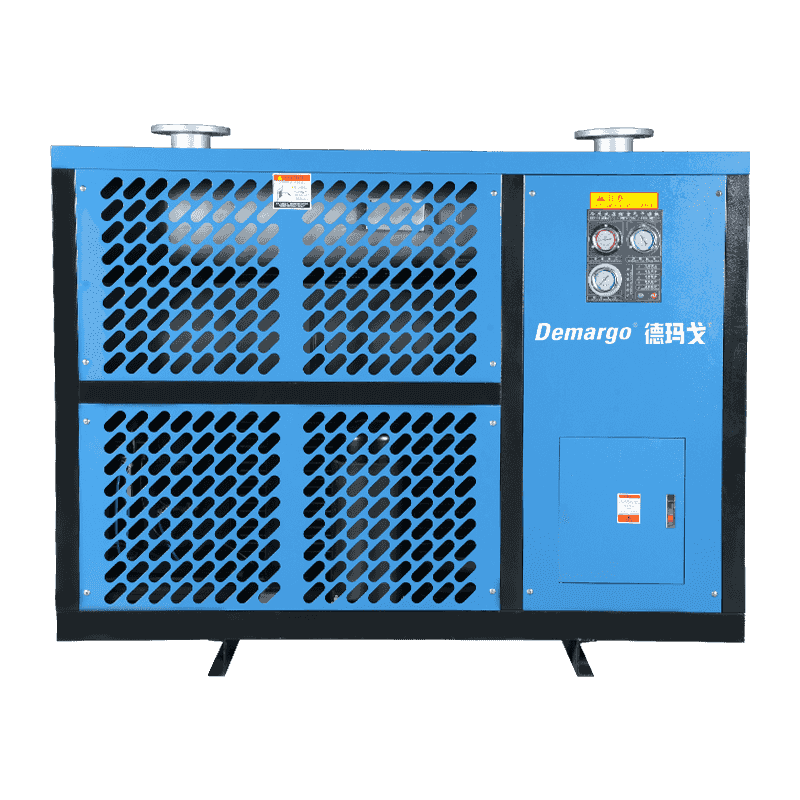
Where this single stage falls short is in applications where the downstream environment drops well below freezing, such as outdoor instrument lines in cold climates, or where the process itself demands a much drier air stream, such as powder handling, optical coating, or moisture-sensitive packaging film production. In those cases, a refrigerated stage alone cannot reach the required dew point, and a secondary drying mechanism becomes necessary.
| Application Type | Typical Required PDP | Single-Stage Sufficient |
|---|---|---|
| General workshop tools | 3 C to 10 C | Yes |
| Outdoor piping, temperate climate | 0 C to 3 C | Often |
| Outdoor piping, cold climate | -20 C or lower | No |
| Electronics or optical processes | -40 C or lower | No |
| Pharmaceutical or powder handling | -40 C to -70 C | No |
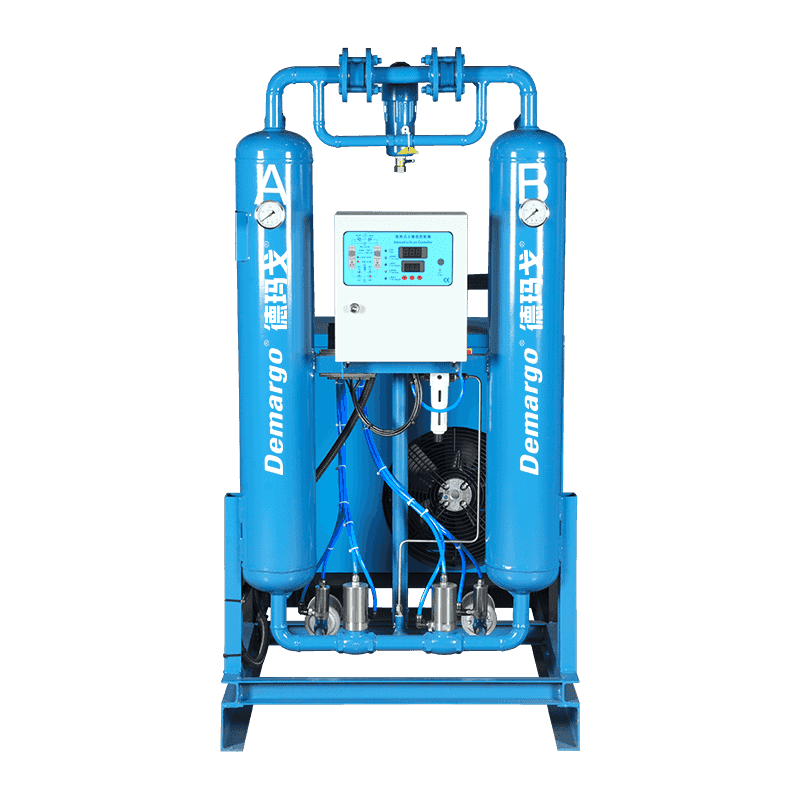
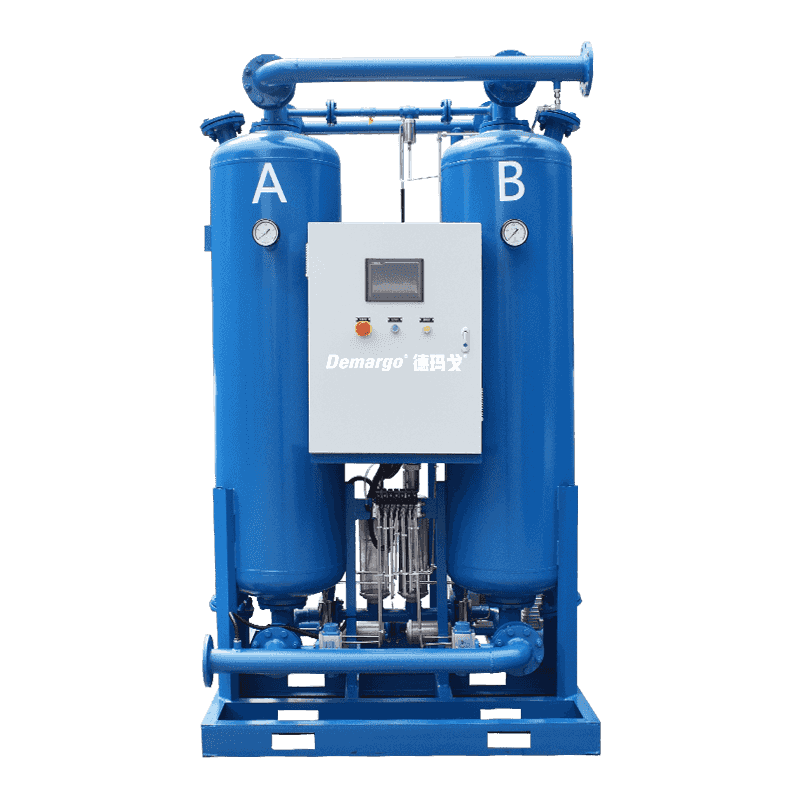
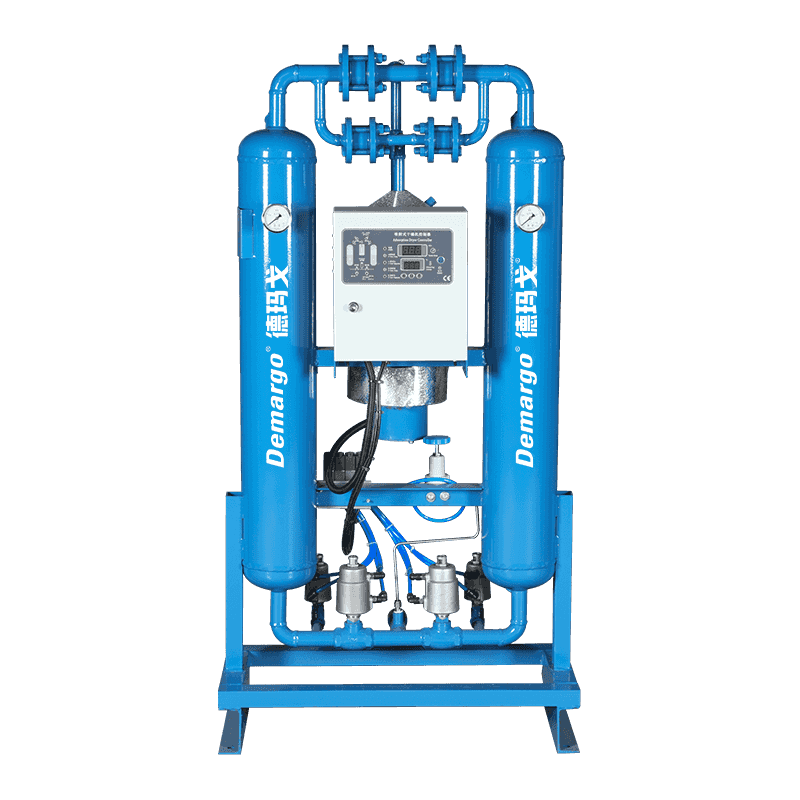
An adsorption dryer uses a solid desiccant material, commonly activated alumina or molecular sieve, to physically bind water molecules onto its surface as air passes through a packed bed. Unlike refrigerated cooling, which relies on lowering temperature to condense water out, adsorption relies on the desiccant's surface chemistry to strip vapor directly from the air stream. This mechanism allows adsorption systems to reach far lower dew points, frequently in the range of minus forty to minus seventy degrees Celsius, depending on desiccant type and regeneration method.
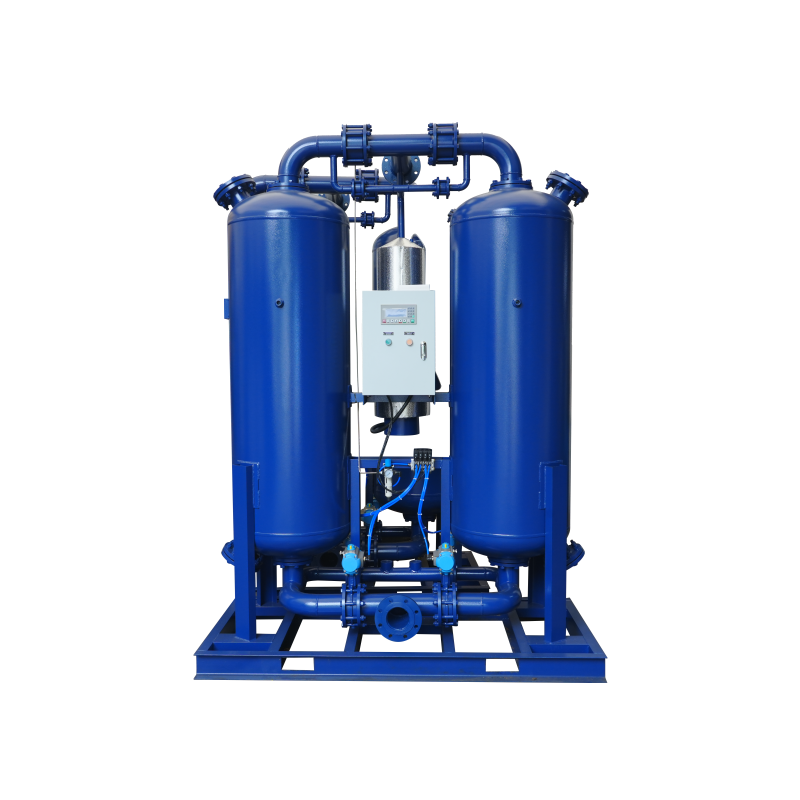
The double tower configuration is the standard architecture for continuous operation. While one tower is actively drying the incoming air stream, the second tower is being regenerated, meaning its saturated desiccant bed is having accumulated moisture driven off so it can be put back into service. Two common regeneration approaches are used:
The towers switch roles on a timed or dew-point-triggered cycle, so the outlet air stream remains continuously dry even as the desiccant bed inside each tower moves through its own saturation and regeneration phases.
Because adsorption relies on a finite desiccant surface area, the effectiveness of the system depends heavily on inlet air condition. Pre-filtration to remove bulk liquid and oil aerosol upstream of the towers extends desiccant life and preserves the achievable dew point over time, which is why adsorption dryers are almost always installed downstream of a primary cooling or separation stage rather than directly after the compressor.
A combined system integrates a primary cooling or separation stage with a secondary adsorption stage into a single engineered package, rather than treating them as two independently sized and installed units. The primary stage handles the bulk of the moisture load, removing the majority of water vapor and bulk condensate before the air ever reaches the desiccant beds. The adsorption stage then only needs to strip the remaining, much smaller fraction of vapor to reach an ultra-low dew point.
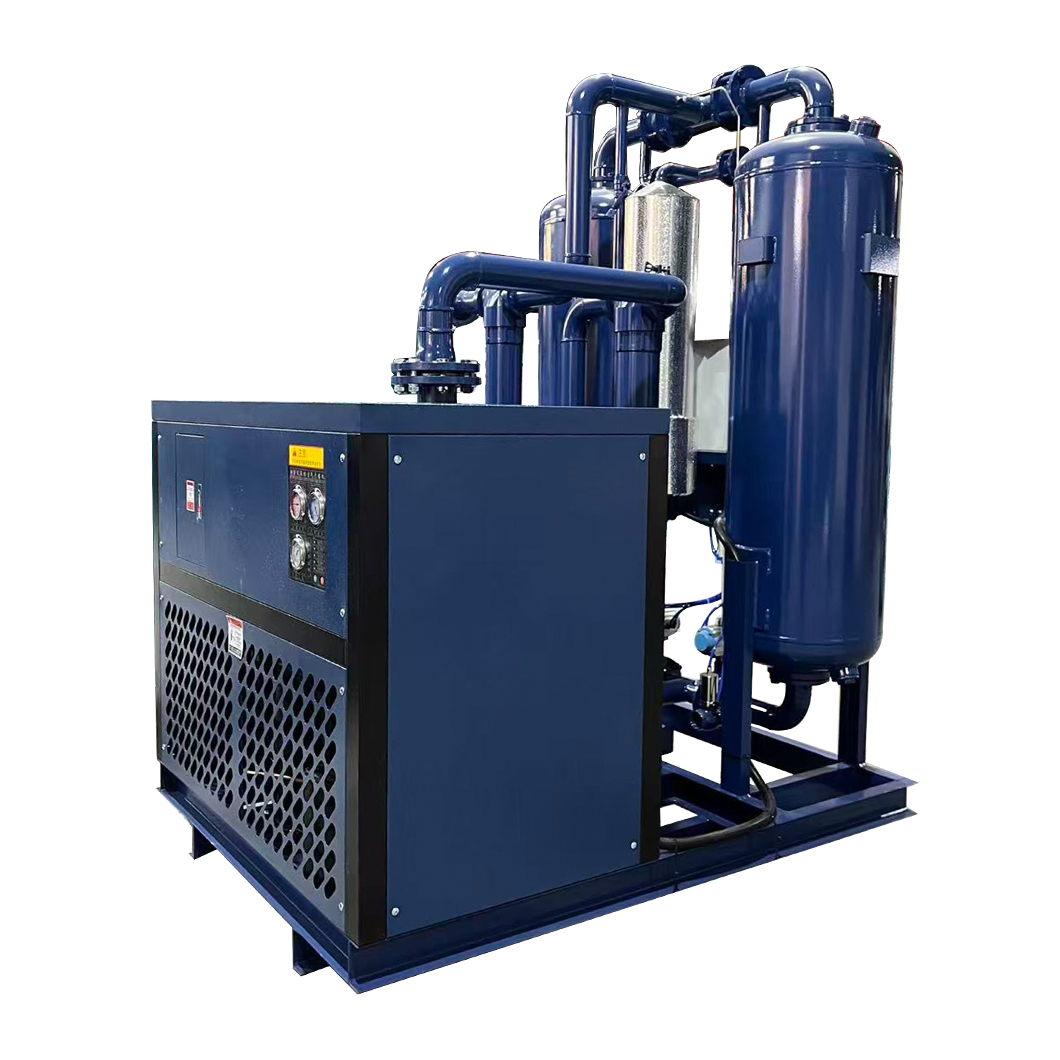
This staged approach has a direct practical benefit: it reduces the moisture load presented to the desiccant beds, which extends the interval between regeneration cycles and reduces the purge air volume consumed during heatless regeneration. In field data collected across general industrial installations, pairing a pre-cooling stage ahead of adsorption has been reported to reduce purge air consumption by a meaningful margin compared to adsorption drying alone, since less water needs to be desorbed per cycle.
Staging a cooling process ahead of adsorption does not just improve dew point, it protects the economics of the whole system by reducing how hard the desiccant bed has to work on every cycle.
Combined units are typically specified as a single footprint with shared controls, which also simplifies dew point monitoring. A single sensor placed at the final outlet gives an accurate read on system performance, rather than requiring separate monitoring points across two independently controlled units.
Selecting between a standalone refrigerated stage, a standalone adsorption stage, or a combined package depends on the dew point target, the moisture load, and the operating cost tolerance of the facility. The table below summarizes the practical tradeoffs.
| Technology | Typical PDP Range | Energy Profile | Best Fit |
|---|---|---|---|
| Refrigerated only | 3 C to 10 C | Lower running cost | General plant air, tools |
| Adsorption only | -40 C to -70 C | Higher due to purge or heat loss | Cold climate or dry-process lines |
| Combined system | -40 C to -70 C | Reduced versus adsorption alone | High-volume dry air with cost control |
Facilities that only need protection against occasional cold snaps often find a standalone refrigerated stage adequate, provided the piping is well insulated and does not run through unheated exterior spaces. Facilities running continuous, high-volume dry air demand, such as film extrusion lines or fiber optic cable production, tend to see a faster return on investment from a combined package because the reduced purge air loss compounds over thousands of operating hours per year.
Choosing a drying configuration should start with the actual downstream requirement, not the compressor's rated output. A few questions help narrow the decision:
For instrument air supplying sensitive control systems, many specifications call for a dew point at least ten degrees Celsius below the lowest expected ambient temperature as a safety margin. This margin accounts for pressure fluctuations and sensor drift over time, and it is one of the most common reasons facilities move from a single-stage to a combined drying approach even when the calculated minimum requirement seems only marginally lower than what refrigeration alone can deliver.
The performance of any adsorption-based system degrades gradually as the desiccant bed approaches saturation, and this degradation is not always visible without active monitoring. A dew point that creeps upward over weeks or months is far more common than a sudden failure, which is why relying on a fixed regeneration timer without dew point verification can leave a facility exposed to slow, undetected moisture creep.
Practical steps for managing desiccant performance over the system's service life include:
Preventing downstream condensation is ultimately a matter of consistency rather than peak performance. A system that reaches an excellent dew point on day one but drifts upward unnoticed over the following year provides little practical protection compared to a system that is monitored and maintained to hold a stable, verified dew point across its full service interval.
Pressure dew point is measured at the actual operating pressure of the compressed air system, while atmospheric dew point refers to the same air at standard atmospheric pressure. Because compression concentrates moisture, the pressure dew point of a given air stream is always higher than its equivalent atmospheric dew point, which is why compressed air specifications reference PDP rather than atmospheric dew point.
Lower dew point systems generally consume more energy through purge air loss or heater operation, and they require more careful desiccant maintenance. Specifying a system well beyond what the process actually needs adds ongoing operating cost without a corresponding quality or reliability benefit, so matching the dew point target to the real downstream requirement is the more cost-effective approach.
Service life varies with air quality, contamination load, and operating cycles, but desiccant media in a well-maintained system with proper pre-filtration commonly remains effective for several years before replacement is needed. Facilities with poor upstream filtration or frequent oil carryover typically see shorter desiccant life and should budget for more frequent inspection.
In many cases an adsorption stage can be added downstream of an existing refrigerated dryer to create an effectively combined configuration, provided the existing unit has adequate capacity and the piping layout allows for the additional footprint. A proper capacity assessment of the existing primary stage is recommended before adding a secondary drying stage.
Sudden dew point rise is most often caused by a failed or bypassed regeneration cycle, a cracked or channeled desiccant bed allowing air to bypass the media, or a upstream pre-filter failure that overwhelms the desiccant with liquid water or oil. Checking these three areas in sequence typically identifies the root cause quickly.
Related Products

ADD: No. 9, Lane 38, Caoli Road, Fengjing Town, Jinshan District, Shanghai, China
Tel: 0086-17321147609
Email: [email protected]
Copyright © Demargo (Shanghai) Energy Saving Technology Co., Ltd. Rights Reserved. Privacy Custom Gas Purifiers Factory