INQUIRE NOW
Demargo (Shanghai) Energy Saving Technology Co., Ltd.
2024-12-17The difference between a refrigerated air dryer and an adsorption dryer?
2024-12-17Principle and application of modular dryer?
2024-12-17Precautions for using refrigerated air dryers?
2024-12-17Exploring the secrets of future food preservation: Entering the world of high-efficiency freeze-drying technology - refrigerated air dryer
2025-02-20Content
In modern industrial environments, compressed air is widely treated as a utility comparable to electricity or water. However, unlike these utilities, compressed air is also a process medium, meaning its physical and chemical properties can directly affect product quality, equipment reliability, regulatory compliance, and long-term operating cost.
Among the key parameters used to define compressed air quality—solid particles, oil content, and moisture—moisture is often the most complex to manage and verify. Moisture behavior in compressed air systems is not static. It changes dynamically with pressure, temperature, flow conditions, and system design.
For this reason, pressure dew point (PDP) has become a central engineering metric for defining, monitoring, and auditing compressed air moisture performance.
From a system-engineering perspective, pressure dew point is not only a specification value. It is:
Understanding the role of pressure dew point requires moving beyond a component-level view of dryers and toward a holistic compressed air system model that includes generation, treatment, distribution, and point-of-use requirements.
Dew point, in general, is the temperature at which water vapor in a gas begins to condense into liquid water. In compressed air engineering, two distinct definitions are commonly encountered:
Pressure dew point is the correct and relevant parameter for compressed air systems. It reflects the moisture behavior of air under pressure, inside pipes, receivers, and downstream equipment.
From a system design perspective, PDP is critical because:
Moisture capacity of air changes with pressure. At higher pressure, the same mass of water vapor corresponds to a higher relative humidity condition and a higher effective dew point temperature.
This means:
This pressure dependency is one of the main sources of compliance errors in compressed air audits. Systems may appear compliant based on raw measurements but fail classification after pressure normalization. ([Compressed Air Best Practices][1])
ISO 8573-1 is the most widely applied international standard for compressed air quality classification. It defines air purity in three dimensions:
Within this framework, pressure dew point is the primary compliance variable for moisture.
The standard specifies moisture classes based on maximum allowable PDP values under defined reference conditions.
| Moisture Class | Typical PDP Limit | Engineering Interpretation |
|---|---|---|
| Class 1 | Very low PDP | Ultra-dry air for critical electronics, pharma, specialty processes |
| Class 2 | Low PDP | Dry air for instrumentation, cold environments |
| Class 3 | Moderate PDP | General industrial dry air |
| Class 4 | Near ambient | Air suitable for non-critical processes |
| Class 5+ | High PDP | Air may contain free water under many conditions |
(Exact values depend on the standard revision and reference conditions.)
From a compliance standpoint, the key point is:
Pressure dew point is not optional documentation. It is the formal moisture compliance parameter.
ISO standards require pressure dew point values to be referenced to defined conditions (commonly 20°C and 7 bar or equivalent). This is done to:
Failure to apply reference conversions is a common compliance risk, particularly in systems operating at lower or variable pressures. ([Compressed Air Best Practices][1])
When pressure dew point exceeds the lowest temperature in any part of the system, condensation becomes thermodynamically inevitable.
System-level consequences include:
From a reliability engineering standpoint, condensation transforms moisture from a gas-phase contaminant into a multi-phase system problem involving corrosion chemistry, fluid mechanics, and microbiological risk.
In cold ambient conditions or refrigerated process areas, inadequate PDP margins can result in:
Here, pressure dew point becomes a safety-critical design parameter, not just a quality variable.
In regulated and quality-critical industries, moisture can act as a vector for:
In these environments, pressure dew point is directly linked to product conformity and audit outcomes, not merely equipment protection.
From a system perspective, moisture originates from:
Moisture management is therefore a distributed system challenge, not a single component function.
Common compressed air drying technologies include:
Each technology corresponds to a different achievable pressure dew point range and energy profile.
For low and ultra-low PDP requirements, adsorption technologies dominate system designs.
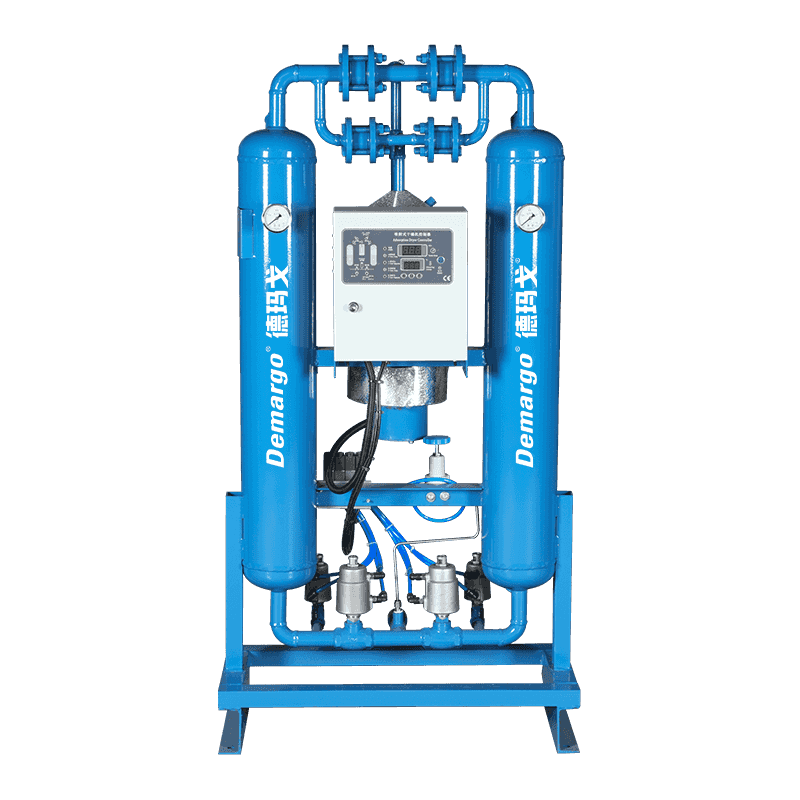
A low dew point heatless regenerative adsorption compressor air dryer is designed to:
From a system-engineering perspective, these dryers:
Heatless regenerative designs are widely used where:
However, they also introduce system-level considerations:
Therefore, pressure dew point compliance in these systems is a function of both dryer design and overall system integration.
In compliance audits, pressure dew point is used to:
Key audit expectations typically include:
From a risk management standpoint:
For systems relying on adsorption drying, continuous PDP monitoring supports:
This shifts pressure dew point from a static specification to a dynamic control variable.
Not all applications require the same PDP. Over-drying can increase cost without adding value, while under-drying increases risk.
A system-engineering approach aligns PDP targets with:
Even when a low PDP is achieved at the dryer outlet, distribution design can compromise performance through:
Therefore, pressure dew point compliance is only as strong as the weakest thermal and hydraulic point in the system.
| Strategy | Typical PDP Range | System Complexity | Compliance Risk Profile |
|---|---|---|---|
| Refrigerated drying | Moderate | Low | Higher in cold environments |
| Heated adsorption | Low to very low | Medium to high | Lower, with higher energy use |
| Heatless adsorption | Low to very low | Medium | Moderate, dependent on purge and desiccant |
| Hybrid systems | Application-specific | High | Optimized for critical environments |
This table illustrates that pressure dew point is a system design output, not a component attribute.
In adsorption systems, desiccant performance degrades over time due to:
As desiccant performance changes, pressure dew point stability can drift upward gradually, creating hidden compliance risks.
From a lifecycle engineering perspective, PDP compliance requires:
This reinforces that pressure dew point is a managed variable, not a fixed rating.
Pressure dew point plays a central role in compressed air quality compliance because it defines when and where moisture will condense under real operating conditions. From a system-engineering standpoint, PDP is not merely a measurement value—it is a control boundary that influences reliability, safety, regulatory exposure, and lifecycle cost.
Key conclusions include:
In modern industrial systems, pressure dew point should be treated as a system-level design and control variable—not just a dryer outlet specification.
Q1: Why is pressure dew point used instead of relative humidity for compressed air compliance?
Pressure dew point directly indicates condensation risk under pressure. Relative humidity does not reliably predict condensation behavior in compressed systems.
Q2: Can a system appear compliant at operating pressure but fail after reference conversion?
Yes. Without proper normalization, raw PDP readings may underestimate true moisture classification.
Q3: Is lower pressure dew point always better?
Not necessarily. PDP should be matched to application risk. Over-drying can increase cost without improving outcomes.
Q4: How does a low dew point heatless regenerative adsorption compressor air dryer support compliance?
It provides stable low PDP capability suitable for critical applications, but system integration and monitoring determine long-term compliance.
Q5: Does distribution piping affect pressure dew point compliance?
Yes. Thermal gradients, insulation, and drainage design can create localized condensation even when dryer PDP is compliant.

ADD: No. 9, Lane 38, Caoli Road, Fengjing Town, Jinshan District, Shanghai, China
Tel: 0086-17321147609
Email: [email protected]
Copyright © Demargo (Shanghai) Energy Saving Technology Co., Ltd. Rights Reserved. Custom Gas Purifiers Factory