INQUIRE NOW
Demargo (Shanghai) Energy Saving Technology Co., Ltd.
2024-12-17The difference between a refrigerated air dryer and an adsorption dryer?
2024-12-17Principle and application of modular dryer?
2024-12-17Precautions for using refrigerated air dryers?
2024-12-17Exploring the secrets of future food preservation: Entering the world of high-efficiency freeze-drying technology - refrigerated air dryer
2025-02-20Content
Pressure swing adsorption (PSA) is the core thermodynamic principle that powers modern Heatless desiccant air dryer systems. Unlike temperature-driven regeneration, PSA relies on manipulating partial pressure to alternately capture and release water vapor from a desiccant bed. When compressed air enters the tower at elevated pressure (typically 5–10 barg), the partial pressure of water vapor increases proportionally, forcing moisture molecules into the micropores of activated alumina or molecular sieve adsorbents. This physical adsorption process continues until the desiccant approaches its dynamic capacity limit. Regeneration occurs by depressurizing the tower to near-atmospheric pressure, which drastically reduces the water vapor partial pressure and allows dry purge air to strip away the collected moisture. The entire cycle typically completes within 4–10 minutes, making PSA one of the most responsive drying mechanisms for continuous industrial operation.
Quantitatively, a pressure increase from 1 bar to 7 bar can boost the equilibrium water adsorption capacity of activated alumina by 350–450%, depending on temperature and relative humidity. This non-linear relationship explains why heatless dryers achieve pressure dew points (PDP) as low as -40°C with only 15–20% purge air consumption. The absence of external heating elements reduces mechanical complexity and eliminates risks associated with overheating desiccants, such as accelerated aging or fragmentation. However, PSA efficiency depends heavily on precise valve sequencing, desiccant bed geometry, and cycle timing — factors that define the difference between a compliant system and an optimized industrial asset.
Field data from over 200 industrial installations indicate that properly tuned PSA-based heatless dryers maintain outlet PDP below -40°C for more than 98% of operating hours when inlet conditions remain within design limits (inlet temperature ≤35°C, relative water load ≤0.5 g/m³). Any deviation, such as a 5°C rise in inlet temperature, can increase required purge flow by 10–15% to preserve dew point performance.
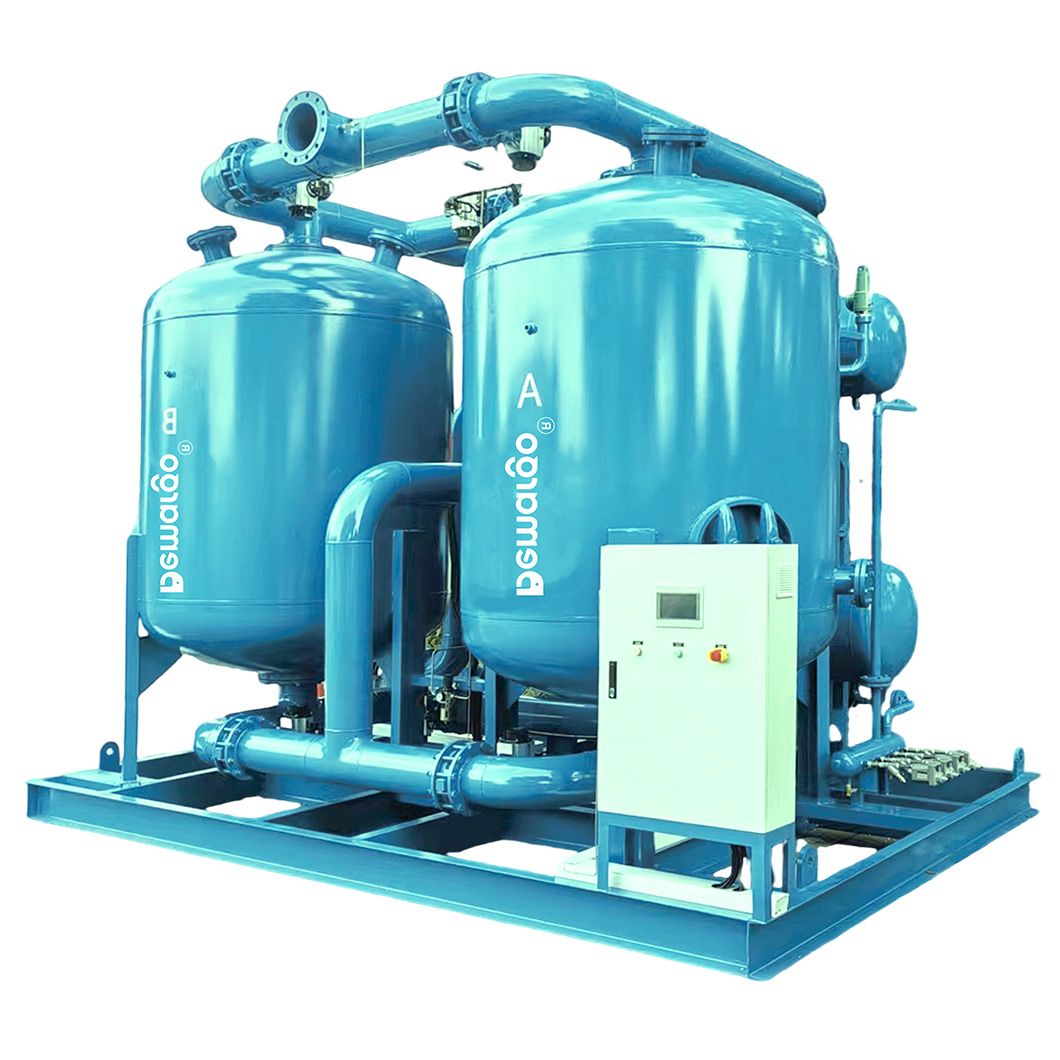
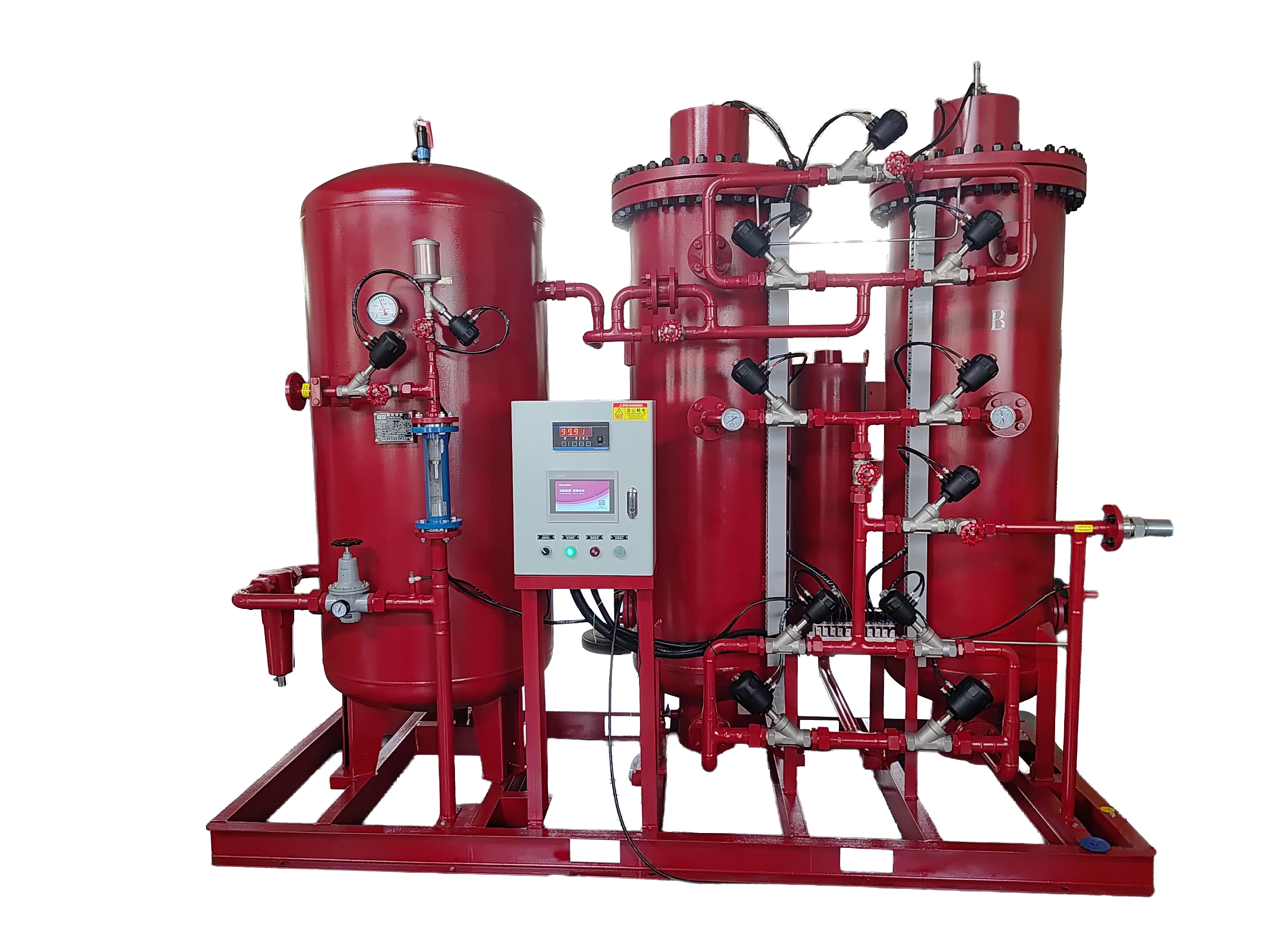
A standard Pressure swing adsorption dryer employs two identical vessels filled with desiccant. While Tower A dries the incoming compressed air, Tower B undergoes regeneration. A programmable logic controller (PLC) orchestrates pneumatic or solenoid valves to alternate the towers every 4–10 minutes. Critical components include inlet isolation valves, outlet check valves, purge control valves, and an equalization valve. The regeneration process consumes 12–18% of the rated dryer capacity as purge air — a necessary operational expense that can be minimized through advanced nozzle designs or adaptive cycle timing.
Figure 1: Simplified PSA cycle in a heatless desiccant dryer — Tower A actively dries compressed air while Tower B regenerates using a portion of dried air as purge.
In a standard 10-minute cycle: 4.5 minutes adsorption for Tower A, 4.5 minutes regeneration for Tower B (including 30 seconds of depressurization and repressurization), plus 1 minute for pressure equalization between towers. Purge air flow is typically regulated at 15–20% of the dryer’s full-flow rating. For a 10 m³/min dryer at 7 barg, purge consumption equals 1.5–2.0 m³/min of dried air, which is expanded to atmospheric pressure before passing through the regenerating tower. This ensures effective moisture stripping without requiring external heat, although energy losses from compressed air blow-off remain the primary inefficiency.
| Parameter | Value Range | Impact on Dew Point |
|---|---|---|
| Cycle time (adsorption) | 4–8 minutes | Shorter cycles reduce bed saturation but increase valve wear |
| Purge-to-flow ratio | 12–20% | Lower ratio raises dew point; optimal 15% for -40°C |
| Inlet pressure (barg) | 5–10 | Higher pressure improves adsorption, reduces purge requirement |
| Desiccant type | Activated alumina / 3A-4A zeolite | Zeolite achieves -70°C but needs more regeneration energy |
A -40°C pressure dew point is the benchmark for many critical applications including pharmaceutical manufacturing, electronics assembly, and instrument air systems. This specification corresponds to an atmospheric dew point of approximately -54°C and represents less than 0.13 g/m³ residual moisture. The Dew point -40°C air dryer must consistently meet ISO 8573-1:2010 Class 2 or better. Real-world performance depends on five key variables: inlet temperature, operating pressure, desiccant age, pre-filtration efficiency, and purge air flow stability.
Case studies from a multinational automotive paint shop: after upgrading from a standard -20°C dryer to a PSA-based -40°C dryer, defect rates from moisture-induced blistering fell by 62% over six months. The dryer operated at 8 barg, 28°C inlet, using 16% purge air, maintaining dew point between -42°C and -39°C over 8,000 hours. Regular performance verification using a calibrated chilled-mirror hygrometer is recommended every 500 operating hours for critical applications.
For facilities requiring continuous -40°C PDP, implementing a dew-point dependent purge control (DPC) can reduce average purge consumption by 25–35% by dynamically reducing regeneration flow when the desiccant bed is partially dry. DPC systems monitor the outlet dew point and trim the purge valve opening, achieving annual compressed air savings of 50,000–100,000 m³ for a medium-sized industrial plant.
Purge air is the largest operational expense in a heatless desiccant dryer. At 15% purge-to-flow, a 5 m³/min dryer operating 8,000 hours annually consumes 360,000 m³ of compressed air worth approximately $8,000–12,000 in electricity (assuming $0.08–0.12 per kWh and 0.15 kWh/m³ specific power). Therefore, even a 5% absolute reduction in purge yields significant savings. Several proven technologies mitigate purge waste without compromising dew point:
A European food packaging plant reduced total compressed air consumption by 18% after retrofitting their existing heatless dryers with adaptive cycle controllers. The payback period was 11 months, and the -40°C PDP remained stable across seasonal inlet temperature variations (-10°C to +35°C ambient). Without such optimization, many facilities unknowingly oversize purge flow, sometimes reaching 22–25% of rated capacity, which wastes energy and increases the load on upstream compressors.
A Combined air dryer system integrates a refrigeration air dryer (to reduce inlet water load) followed by a heatless desiccant dryer. This arrangement allows the desiccant dryer to handle only residual moisture (typically 0.5–1.0 g/m³) instead of full saturated air (up to 8 g/m³ at 35°C). The result: purge air can be reduced to 8–12% of rated flow, and desiccant life extends by 30–50% due to lower thermal and hydraulic stress. Combined systems are the go-to solution for industrial applications demanding -40°C PDP with moderate energy budgets.
Performance comparison: For a 20 m³/min system at 7 barg, 35°C inlet, a standalone PSA dryer requires 18% purge (3.6 m³/min). A combined dryer (refrigeration pre-cooling to 5°C + heatless desiccant) reduces inlet moisture by 85%, allowing the desiccant dryer to operate at 10% purge (2.0 m³/min). Net compressed air saving equals 1.6 m³/min, or 768,000 m³ annually. Additionally, the refrigeration dryer consumes about 1.2 kW electrical power, which is minor compared to the air savings.
| Configuration | Purge air consumption | Desiccant lifetime | Total cost of ownership (5 years) |
|---|---|---|---|
| Standalone PSA dryer (-40°C) | 15–18% | 18–24 months | $48,000–62,000 |
| Combined dryer (refrig. + PSA) | 8–12% | 32–40 months | $39,000–51,000 |
| Heatless with DPC control | 12–14% (avg.) | 22–28 months | $44,000–56,000 |
PSA-based Industrial air dryer solutions are deployed across sectors where compressed air purity directly impacts product quality, process stability, or equipment longevity. Below are representative cases without brand references, illustrating quantitative outcomes:
These examples confirm that proper PSA design, combined with application-specific tuning, delivers reliable -40°C dew point while maintaining purge between 8% and 18% depending on inlet conditions and pre-treatment.
When selecting a heatless PSA dryer for -40°C PDP, engineers must account for correction factors. Standard catalog ratings are based on 7 barg, 35°C inlet, and 20°C ambient. If your site conditions differ, apply the following derating: for every 3°C above 35°C inlet, multiply required dryer capacity by 1.15; for pressures below 6 barg, multiply by 1.25. Always include a safety margin of 15–20% for future expansion or temporary overloads.
Activated alumina (standard) works well for -40°C, but molecular sieve (4A or 13X) can achieve -70°C to -100°C with higher purge. For most industrial -40°C requirements, activated alumina with a 3–5 mm bead size offers optimal balance between pressure drop and adsorption kinetics. Upstream coalescing filters (≤0.01 ppm oil carryover) are mandatory to prevent desiccant fouling; oil aerosols dramatically reduce adsorption capacity and can cause “desiccant caking,” leading to channeling and dew point breakthrough. Install a high-efficiency filter with liquid water separator before the dryer.
Finally, monitor pressure differential across each tower; a 0.3 bar increase indicates desiccant dust or fragmentation. Regular back-flushing or desiccant replacement every 2–3 years sustains -40°C performance.
A heatless dryer uses pressure swing adsorption (PSA) and purge air at ambient temperature for regeneration, whereas a heated dryer uses an electric heater or blower to raise regeneration air temperature to 150–200°C, reducing purge air to 6–8% but adding electrical consumption. Heatless dryers are simpler and more reliable for -40°C dew point up to 100 m³/min; heated units become more efficient for larger flows or -70°C requirements.
Yes, provided the dryer is sized correctly and inlet temperature does not exceed 40°C. For tropical climates (ambient >35°C), a combined dryer system with a refrigerated pre-dryer is recommended to reduce moisture load on the desiccant bed, ensuring stable -40°C PDP even at 45°C inlet.
Typical desiccant lifespan is 2–3 years under normal conditions (inlet air quality class 3, proper pre-filtration). Factors that shorten life: high inlet temperature, frequent pressure cycling, or oil contamination. Annual performance testing helps predict replacement needs before dew point degradation occurs.
Clean desiccant beds cause a pressure drop of 0.2–0.35 bar at rated flow. As dust accumulates, drop may reach 0.5 bar, indicating need for desiccant inspection. Properly sized vessels and graded bed layers minimize drop.
Yes, most modern PLC-based dryers accept retrofitted dew point sensors and control algorithms. Payback period is usually 12–18 months, reducing purge consumption by 20–30% while maintaining -40°C performance.
By pre-drying air with a refrigeration dryer (which uses low electrical power), the desiccant dryer requires significantly less purge air (8–12% vs. 15–18%). The net reduction in compressed air waste outweighs the added electricity of the refrigeration unit, lowering total energy cost by 20–35%.
Related Products

ADD: No. 9, Lane 38, Caoli Road, Fengjing Town, Jinshan District, Shanghai, China
Tel: 0086-17321147609
Email: [email protected]
Copyright © Demargo (Shanghai) Energy Saving Technology Co., Ltd. Rights Reserved. Custom Gas Purifiers Factory