INQUIRE NOW
Content
A paper mill in Ontario was losing nearly $4,000 per month because condensation in its instrument air line kept fouling sensor valves across a single paper machine. The compressors were fine. The problem was downstream: the dryer was undersized for the summer load. Most pulp and paper facilities run a similar setup — a central compressor room, long distribution lines, and a series of process points with different air quality requirements. The missing link is often not the compressor but the treatment package that sits beside it.
For a plant manager or a maintenance engineer, this is the place to begin. Compressed air is not a single utility with one specification. It is a process medium with different quality demands at different points in the line. Understanding those differences separates a reliable production line from one that suffers chronic valve failures and unplanned stops.
Compressed air touches nearly every stage of paper production. Here are the main points of use, because the air quality you need changes at each one.
In the pulping area, compressed air powers agitators and pneumatic valves in the stock preparation system. It also operates the blow-off nozzles that separate and clean raw pulp fibers before they reach the forming section. Air here is often in direct contact with the stock, which makes oil carry-over a real contamination risk. Many mills therefore use oil-free compressors or install a dedicated oil removal filter at the point of use.
Once the pulp is diluted and delivered to the forming wire, compressed air runs the slice lip actuators, dewatering elements, and edge trimming devices. These are precision pneumatic components. Water in the air causes solenoid valves to stick and pressure transmitters to drift, which disrupts the basis weight profile and leads to quality rejections.
A modern paper machine has hundreds of air-actuated control valves. They rely on a continuous, stable supply of clean, dry instrument air. The ISO 8573.1 class usually called for here is Class 2 for particles and Class 2 or 3 for pressure dew point.
Pulp bales, waste trim, and coating pigments are often moved with pneumatic conveyors. These systems need large volumes of compressed air, but the quality requirement is lower than instrument air. A refrigerated dryer with a 5-7°C dew point is usually sufficient. If the conveying air is also used to transport starch or coating additives, moisture must be removed to prevent caking and blockages.
In the converting section, compressed air operates winders, tension controls, and packaging lines. It is also used for sheet cleaning and web tensioning. These are less critical, but a system serving them should not be mixed with high-purity instrument air without a final filter.
The standard reference for compressed air quality is ISO 8573.1, which defines purity classes for particles, water, and oil. For pulp and paper, the most commonly specified targets look like this:
| Application | Particle Class | Pressure Dew Point | Oil Content |
|---|---|---|---|
| Instrument air | Class 1-2 | -40°C or colder (desiccant) | Class 1 |
| General plant air | Class 3 | +3°C to +5°C (refrigerated) | Class 3 |
| Pneumatic conveying | Class 4 | +5°C to +10°C | Class 4 |
| Converting equipment | Class 3 | +3°C to +5°C | Class 3 |
A few practical notes on this table. The pressure dew point matters more than absolute moisture content because it directly controls whether condensation forms inside the pipe when the ambient temperature drops. If a mill runs a refrigerated dryer set to +5°C but the distribution line passes through an unheated basement at +2°C, water will condense. The fix is either a lower dew point with desiccant drying or better insulation and heat tracing.
The practical rule: for valves and sensors, a dew point of -40°C is the common target. A refrigeration cycle cannot reach that level. Most mills use a combination: refrigerated drying for the bulk plant air, and a smaller desiccant dryer for the instrument air loop. A heatless regeneration adsorption dryer is often the practical choice for this loop.
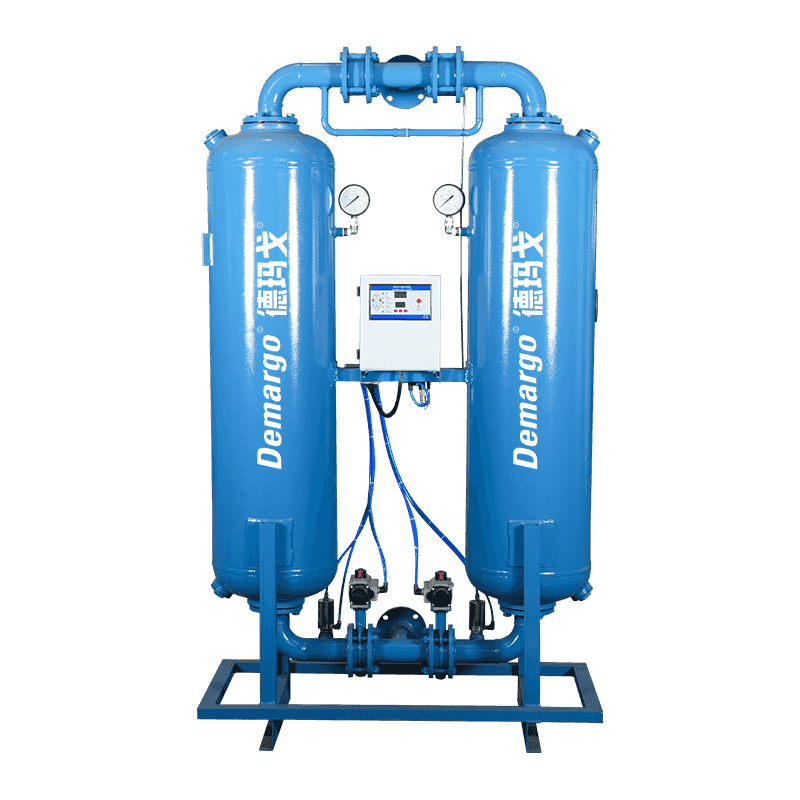 Heatless Pressure Swing Adsorption Dryer for Instrument Air LoopsThis heatless regeneration dryer uses pressure swing adsorption to achieve a -40 °C dew point, making it the practical choice for conditioning the instrument air branch that feeds valves and sensors in a pulp and paper mill.View Product →
Both refrigerated and desiccant dryers have a place in a pulp and paper facility. The decision is not about which one is better in absolute terms; it is about matching the technology to the required dew point.
Refrigerated dryers cool compressed air to about 3-7°C and separate the condensed water. They are the most economical choice for general plant air and fit applications such as pneumatic conveying, general workshop air, and the main plant air header. They cannot produce a dew point below about +3°C, and they are sensitive to inlet temperature. If the compressor runs hot and the dryer is undersized, the outlet dew point rises.
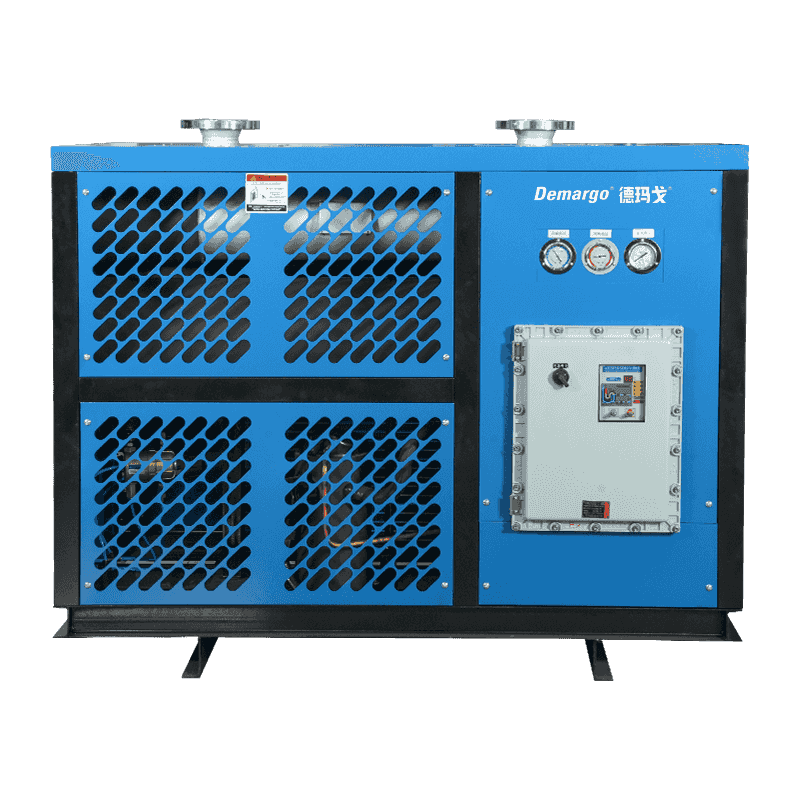
A 400CFM air-cooled refrigerated dryer is a typical size for a midsize paper machine plant air header.
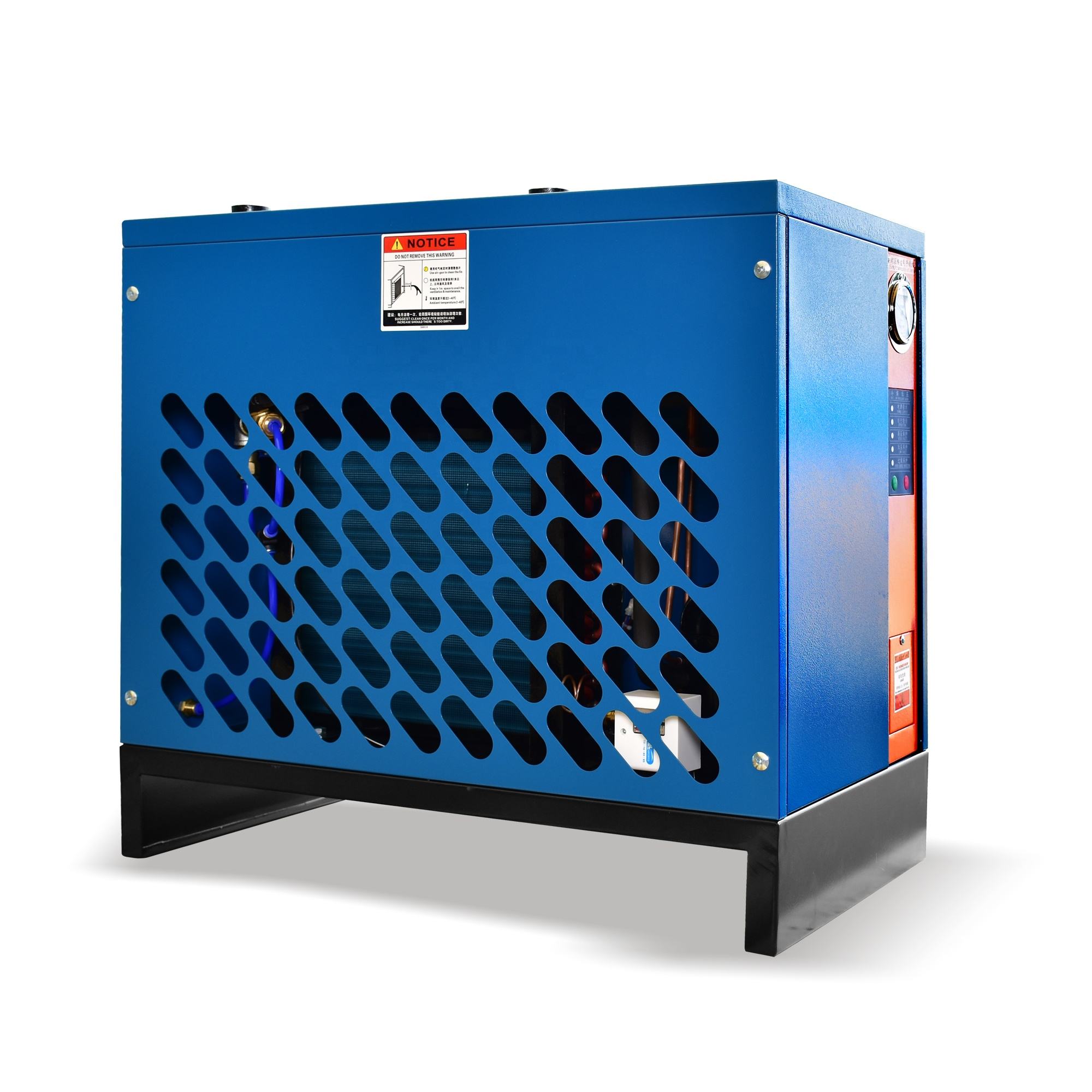 400 CFM Air-Cooled Refrigerated Dryer for Plant Air HeaderA typical midsize unit for the plant air header, this refrigerated dryer removes moisture via cooling and is suited for general compressed air applications where a standard dew point is acceptable.View Product →
Desiccant dryers use a bed of desiccant beads to adsorb water vapor and deliver dew points from -20°C to -70°C. They are the standard choice for instrument air and for processes where moisture can cause stoppages. The trade-off is energy. Regeneration consumes compressed air in heatless units or heat in heated and compression-heat units. Zero air loss units are becoming more common in paper mills because the regeneration air is recovered.
Example energy comparison for a 200 CFM instrument air loop:
Heatless dryer at 15% purge loss: about $18,000 per year in extra compressor energy.
Compression heat zero air loss dryer: about $2,500 per year in extra energy.
This is where energy savings hide. A compression heat zero air loss adsorption dryer can consume less than half the energy of a conventional heatless unit at the same dew point. For a large mill running 200 CFM of instrument air, that difference can translate into tens of thousands of dollars per year.
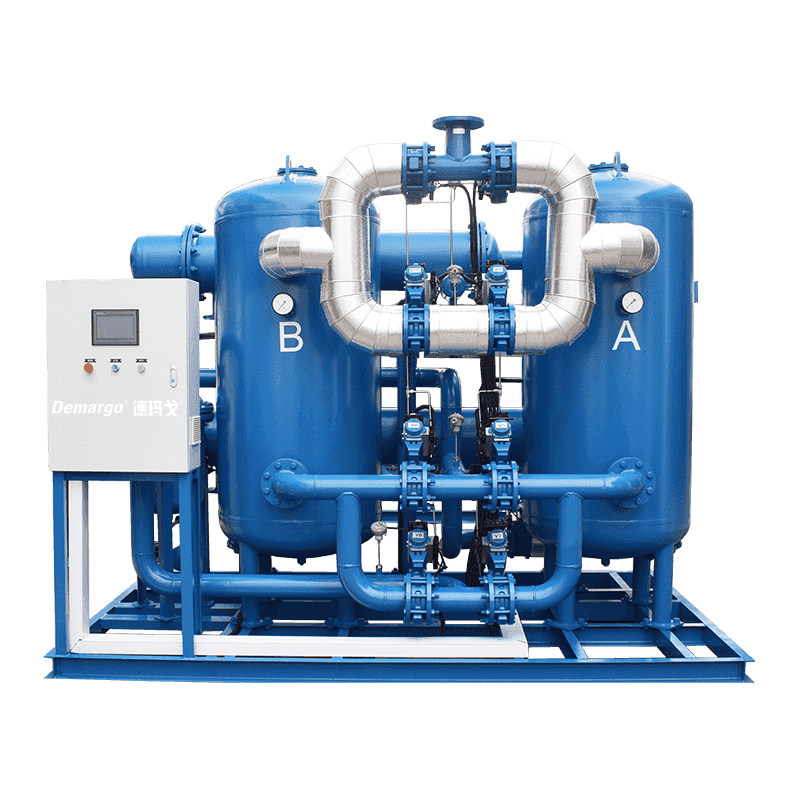 Compression Heat Zero Purge Adsorption Dryer for Energy SavingsBy recovering waste heat from an oil-free compressor, this dryer regenerates desiccant without purge air, cutting energy use significantly compared to heatless units—an attractive option for large instrument air flows.View Product →
In practice, most mills run both. The refrigerated dryer handles the plant air header, while a smaller desiccant dryer conditions the branch that feeds the control valves. If you want to compare the two options in detail, this guide on choosing between refrigerated and desiccant dryers walks through the decision criteria.
Most compressed air problems in paper mills follow the same pattern: a small quality or capacity issue that goes unnoticed until it causes a production stop. Here are the three I see most often, with the root cause and the practical fix.
The plant has a properly sized refrigerated dryer, but water still appears at the remote air station by the boiler room. The root cause is usually the pressure dew point being above the lowest pipe surface temperature. The fix is either to lower the dew point on that branch with a local desiccant dryer or to route that line into a heated, insulated area. If you are already using an automated drain, verify that it is actually discharging; a failed HAD20 float automatic drainer can make a good dryer useless.
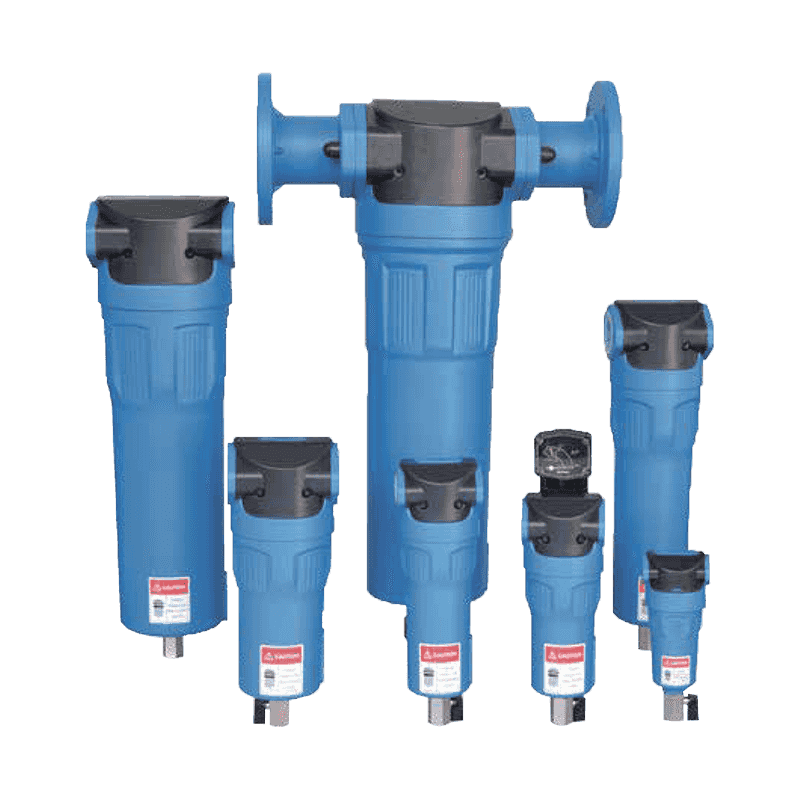
A mill with an oil-lubricated compressor runs only a particulate filter. Oil in the form of aerosol passes through the filter and deposits on solenoid valve spools. The fix is an active oil removal filter installed downstream of the dryer, followed by a particulate guard.
Actuators and conveyors often run simultaneously during grade changes or startup. If the dryer is sized for average demand, the pressure drop across the dryer increases, the dew point rises, and downstream instruments see wet air. The fix is to size the dryer using the same peak CFM used to size the compressor, not the average.
For each of these, the practical approach is to test at the point of use rather than at the compressor outlet. A portable dew point meter and an ISO 8573.1 testing kit give you the actual class of air reaching the machine.
When you are ready to specify a dryer or filter package for a paper mill, here are the factors that matter most. These are the exact points where procurement mistakes are made, and they are often the source of future operational problems.
A standard way to keep the process simple: define the air quality zone, pick the technology that meets that zone, and then verify with a point-of-use test. The product selection can then be narrowed to a few options instead of a full catalog review. For the exact product dimensions, performance curves, and sizing help, visit the Demargo download page.
In most cases, no. Refrigerated dryers only reach a dew point of about +3°C. Instrument air, especially in cold climates or where valves are exposed to low ambient temperatures, needs a dew point no higher than -40°C to prevent condensation. For that, an adsorption dryer is required.
Not always. Oil-free is ideal where air contacts stock or coating directly. But many mills operate with oil-lubricated compressors and succeed with proper downstream filtration. A coalescing filter plus an activated carbon filter can reduce oil content to Class 1 levels.
For critical instrument air, a monthly check is a good baseline. If the plant has a large distribution network, consider a continuous dew point monitor on the main header. Sudden changes usually indicate a drain failure, a refrigeration fault, or an exhausted desiccant bed.
Dryer regeneration purge loss, followed by pressure drop across an oversized filter train. In many mills, dryers account for 15-25% of total compressed air energy consumption. Replacing a heatless desiccant dryer with a zero air loss design can cut that share dramatically.

ADD: No. 9, Lane 38, Caoli Road, Fengjing Town, Jinshan District, Shanghai, China
Tel: 0086-17321147609
Email: [email protected]
Copyright © Demargo (Shanghai) Energy Saving Technology Co., Ltd. Rights Reserved. Privacy Custom Gas Purifiers Factory